
This is part of 9fin’s special report looking at financial distress and M&A in American higher education. Read more here.
Inside the Massry Center for the Arts at the College of Saint Rose in Albany, New York, the acoustic paneling, raked seating and clear sightlines still evoke the design of a serious performance venue.
Yet the stage has long been silent — no “Rosebuds”, as Saint Rose students were called, have performed here in years.
Since the college shuttered three years ago, the center has sat idle as part of a closed campus awaiting a new owner. The property also serves as collateral for $48m in tax-exempt bonds that bondholders are still working to recover.
Ironically, the auditorium saw its largest crowd ever on 1 December, 2023. Built for just 405 people, the hall drew over a thousand students, faculty and community members who crammed into the hallways and packed every available aisle.
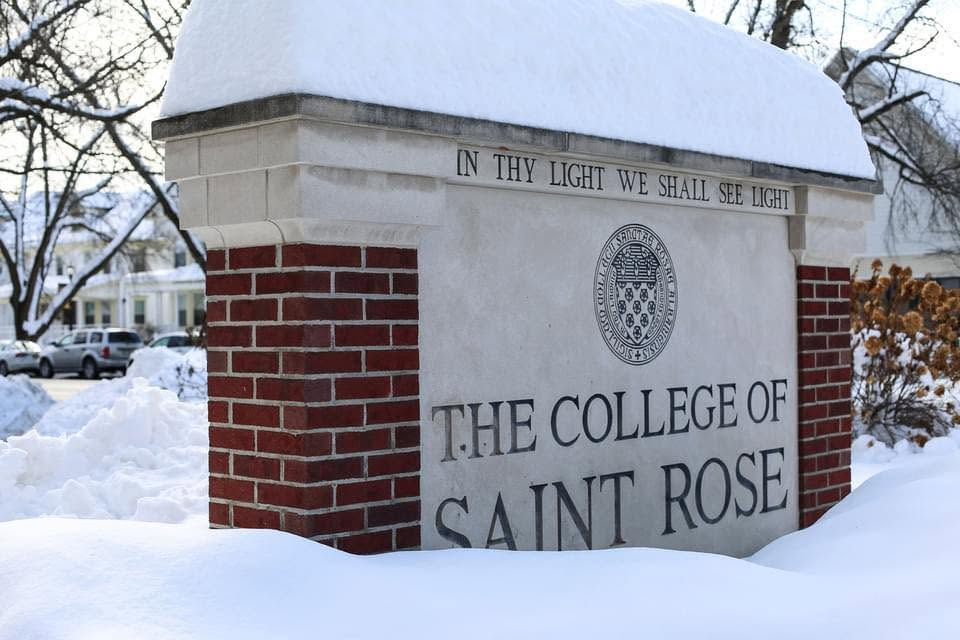
Source: The College of Saint Rose Office of Alumni Relations Facebook page
People had congregated there for the same reason — local news had just broken the story of Saint Rose’s closure before the college itself gave any notice to its faculty, staff or students. During the community meeting, Saint Rose President Marcia J. White, who had dismissed the rumors of the shutdown as “false and misleading” only days prior, officially confirmed the reports: the 103-year-old Catholic institution would permanently close at the end of the 2024 academic year.
“It was absolute chaos, the way we were informed," recalled John Dion, a longtime marketing professor who was among the overflow crowd listening to the announcement over the Massry Center’s sound system.
The following semester, faculty scattered to new jobs while students scrambled to transfer their credits. Left behind was a 72-building, 46-acre campus headed for liquidation — along with roughly $50m in outstanding secured debt incurred from a decade-long expansion plan.
By August 2025, the bond trustee had distributed approximately $24.85m to holders of the Series 2021 bonds — recovering about 51 cents on the dollar of the allowed secured claim, according to the trustee’s 17 July 2025 notice to bondholders.
Saint Rose is far from an isolated case. The New York State Education Department has reported 12 college closures since 2023, while the US Department of Education data shows that 52 higher education institutions have shut down nationwide.
The same financial forces that broke Saint Rose — a shrinking demographic of college-age students, steep tuition discounts eating into revenues, and an unsustainable debt load — continue to strain the balance sheets of dozens of small, tuition-dependent private colleges nationwide.
This account is based on 9fin’s conversations with more than 15 former students, professors, administrators, restructuring advisors and consultants, many of whom were granted anonymity to discuss the confidential details of Saint Rose’s closure and debt negotiations.
White, the college’s final president, and Cullen and Dykman, the legal firm representing the college in its Chapter 11 case, did not respond to requests for comment. Mintz, counsel to the bond trustee, declined to comment.
Failed growth thesis
Founded in 1920 by the Sisters of Saint Joseph, the College of Saint Rose began as a Catholic women’s college with a first class of 19 upstate New York students and a single $1,000 house as its solo asset.
The college went coeducational in 1969, expanding into a comprehensive four-school college spanning the arts, business, education and math and science, with both undergraduate and graduate programs. By the time it filed for Chapter 11, it had graduated over 50,000 alumni.
At its peak in 2010, Saint Rose enrolled 5,130 students. Between 2000 and 2011, the administration launched an aggressive debt-funded expansion to transform the campus, financing new residence halls, a performing arts center, athletic fields, a women’s leadership facility, and extensive real estate acquisitions in Albany’s Pine Hills neighborhood.
When the buildout concluded, the college spanned 72 buildings across 92 parcels — a sprawling footprint designed around a simple growth thesis: modernizing the campus to boost enrollment and cover its debt.
But that failed to materialize. By fall 2023 — the college’s final full academic year — total enrollment had dropped by more than half.
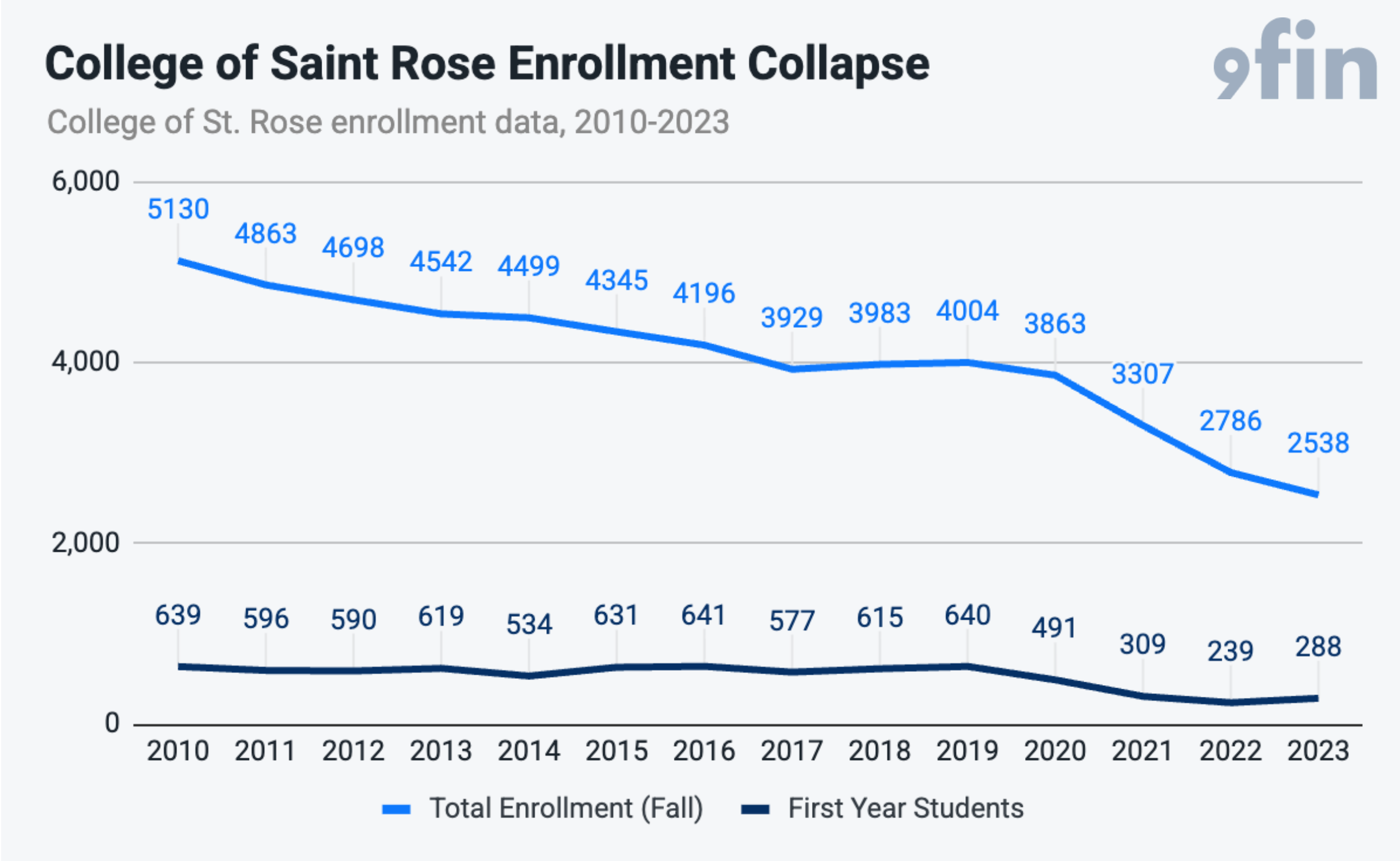
Source: IPEDS enrollment data and National Center for Education Statistics
In 2015, Saint Rose eliminated 27 academic programs and laid off 23 faculty members, including tenured staff, in an effort to address declining enrollment and budget deficits. While faculty noticed the financial strain, many still viewed this as a one-off event tied to specific programs rather than a systemic issue, several former faculty members told 9fin. It never occurred to them that this century-old institution would go bankrupt, they said.
“It was, as an employee, very difficult to understand what was truly going on because the message we received seemed different depending on what the administration's needs were,” one of the former faculty members told 9fin. “If they needed to tell us why we weren't getting raises, it was because the finances were bad. If they wanted to get good publicity, they told the media how wonderful everything was.”
The Covid pandemic only compounded this pressure, particularly as Albany enforced pandemic restrictions much longer than the rest of the country. After welcoming one of its largest-ever incoming classes at over 600 students in 2019, Saint Rose saw freshmen enrollment plummet to the low 300s by fall 2021.
On 12 November 2021, the City of Albany Capital Resource Corporation (CACRC) issued $48.15m of tax-exempt refunding bonds on behalf of Saint Rose, consolidating two prior bond issues that had funded the prior decade’s campus expansion.
Servicing that debt required consistent tuition fee revenue. To attract students from a shrinking applicant pool, however, Saint Rose was forced to steepen its financial aid offers. In higher-education accounting, a tuition discount rate reflects the institutional scholarships and aid applied against the sticker price, cutting the net revenue earned per student.
Saint Rose’s freshman tuition discount rate surged from 54% in the 2015-16 academic year to 67% by 2022-23, according to its first day declaration filings. By its final admissions cycle, the college was collecting under 33 cents on every sticker-price tuition dollar from incoming students.
As enrollment collapsed and debt obligations remained fixed, operating losses mounted rapidly over the college’s final three fiscal years, tax filings show.
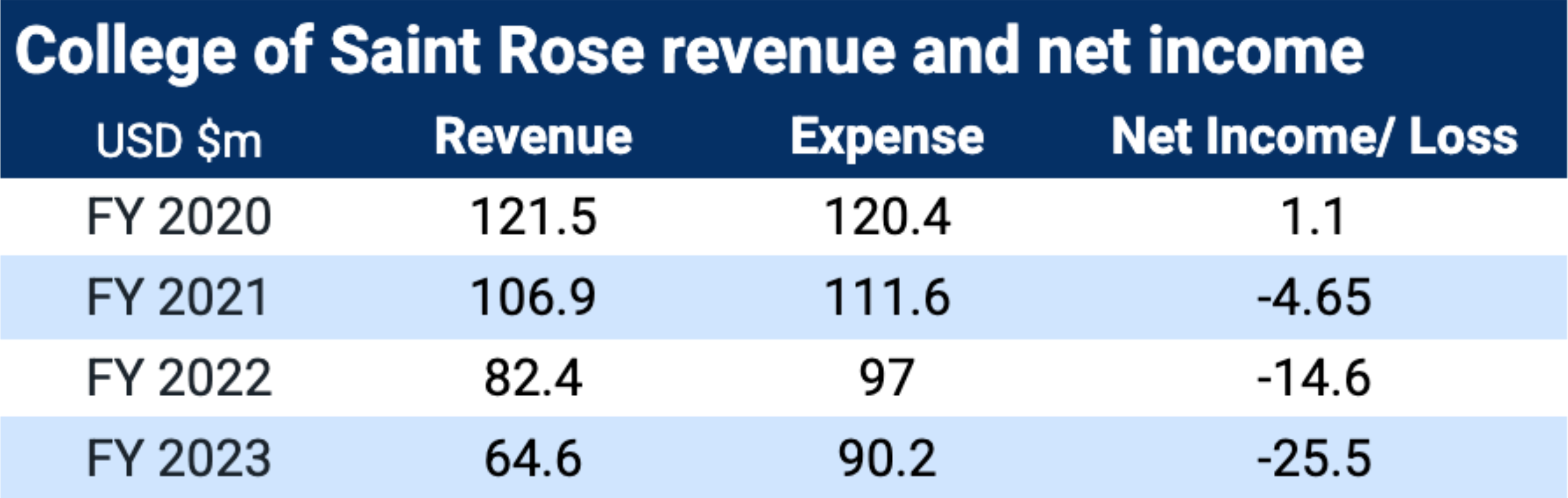
Source: College of Saint Rose Form 990s
To plug operating shortfalls, the administration repeatedly drew down the college’s endowment. Over its final three loss-making years, roughly $28m was spent under the tax filing’s “other expenditures for facilities and programs” line item, including $11.9m in the fiscal year ending 30 June, 2023 alone. The endowment had entered FY 21 with $44m.
During the same period, White’s total reported compensation steadily increased, rising from $296,936 in calendar year 2021 to $348,518 in 2023. That pay level remained consistent with executive salaries at peer institutions, as peer tax filings show presidential compensation at small private colleges in upstate New York ranged from roughly $330,000 to $740,000 that year.
Dead end
As early as fall 2022, Saint Rose had hired advisors to help navigate its growing financial distress, a source told 9fin. On paper, the options were standard: trim costs, refinance, find a merger partner, or wind down.
Cost-cutting had already been underway for years — employee counts dropped to 763 in calendar 2023 from 1,161 in 2022 and 1,224 in 2021, tax filings show — yet failed to alter the trajectory of its operating losses. With the endowment already heavily tapped, Saint Rose turned to public funding.
Over the course of a year, White and board leadership met repeatedly with local, state and federal officials to seek bridge funding that could keep the college afloat long enough to finalize a merger, according to White’s first day declaration.
"Unfortunately, these efforts did not come to fruition in the timeframe needed to provide certainty of sufficient financial resources to complete the 2024-2025 academic year," White wrote.
A merger did seem like a viable path at the time, given that Saint Rose sat in one of the densest higher education regions in the nation. Albany County alone is home to 12 tertiary institutions — including the University at Albany, Rensselaer Polytechnic, Union College, Siena College, Russell Sage College and Albany College of Pharmacy — all just a short drive away.
However, Saint Rose’s debt load frightened off prospective buyers, a source familiar with the negotiations told 9fin. Any potential buyer needed assurance that an acquisition would add value and required a clear plan to address the outstanding debt.
“They're not going to merge with a failing college that owes at that point in time — they owed $50m in debt," said Albany County executive Daniel McCoy. "Why would you want to inherit that $50m?"
The timeline was another hurdle. Even if a willing party had emerged immediately, completing a college merger typically takes around 18 months, a source noted.
FTI Consulting senior managing director Sean Harding, who advises on higher education M&A, said broadly of the sector, “When the yellow lights start flashing, that’s when you need to pivot to what your strategic alternatives are. When the red lights are flashing, it’s oftentimes too late.”
Left with no other viable path, the Board of Trustees voted on 30 November 2023 to end academic operations by 30 June 2024.
The Scatter
Samir Filho, a Brazilian finance major who arrived at Saint Rose on a soccer scholarship in 2022, was sitting in the dining hall when a friend’s phone flashed the news alert: the college was shutting down.
"Everybody was shocked, running around, talking to each other, calling parents," he recalled.
With final exams just weeks away, some professors canceled tests altogether. Within days, the administration shut down athletic facilities for its teams. Students and faculty were left with roughly seven months to secure new schools and employment.
"They said we couldn't use the school, the gym, to play,” Filho said. “We couldn't use the soccer field to play anymore. We couldn't use the gear. They left us from day to night doing nothing.”
For international student-athletes like Filho, transferring meant clearing two hurdles — maintaining continuous enrollment to satisfy visa requirements, and finding a school willing to take them on while matching their financial aid. Filho feared he would have to return to Brazil. He and several teammates spent the following weeks scrambling to secure transfer offers before their visas lapsed, saying goodbye to friends they had planned to live with the following semester.
Faculty faced an equally desperate timeline. Academic hiring cycles typically run from summer through early fall. By the time Saint Rose confirmed its closure in December, most institutions had already locked in their faculty positions for the coming year, leaving many professors stranded.
Haidy Brown, who had been a management professor at Saint Rose from 2017, managed to secure a position at nearby Russell Sage College. But others were not as fortunate. Brown noted that colleagues who landed new academic roles often wrestled with survivor’s guilt, while others grew bitter toward the administration. Some tenured full professors ended up waiting tables or working in bookstores.
The shutdown also had ripple effects on the region’s healthcare pipeline and clinical capacity. Speech-language pathology already suffers from a national workforce shortage, according to a former Saint Rose professor David DeBonis. Saint Rose operated an on-site clinic that trained graduate students while providing roughly 200 patient visits each week. Its Neuro Services Program alone served 63 adults weekly across 22 groups for brain injury, stroke, and neurodegenerative conditions, noted Aphasia program director Julie Hart. When the college closed, the clinic shuttered along with it.
Across student and faculty accounts, the breakdown in communication remained a central grievance. When rumors of a shutdown first circulated at the start of the fall semester, campus leadership publicly dismissed them as “all fake,” reassuring the community that the college was financially sound. Professor John Dion recalled learning the news via text message — just one day after being assured at a faculty meeting that a merger was actively underway.
Despite the transfer arrangements and job searches, key elements of Saint Rose could not be salvaged. A century of Catholic tradition, the Golden Knights banner in the gymnasium, a 50,000-strong alumni network, and the vulnerable patients who relied on weekly clinic care — none of it transferred alongside the student transcripts or property deeds. Those pieces of Saint Rose remained behind when the doors were finally locked for good.
Reclamation
In the months following the closure announcement, Saint Rose established teach-out agreements — formal arrangements ensuring partner institutions accept credits from a shuttering school — with 21 colleges covering 785 students. Russell Sage, located just a 10 minute walk away, absorbed 372 of those students. It took over Saint Rose’s speech-language pathology program and a portion of the neuroservices program.
Russell Sage also hired nine former Saint Rose faculty and matched athletic scholarships for incoming transfer athletes, including Filho and several of his teammates. Its President Matthew Shaftel told 9fin that the initiative cost his institution roughly $2.5m, split between roughly $1.2m in financial aid and $1.5m in faculty payroll and infrastructure upgrades.
While students and faculty moved on, the physical campus remained frozen in place. The 46-acre property — comprising 72 buildings across 92 parcels — drew 14 parcel-level bidders during a court-supervised auction in December 2024. However, bankruptcy filings show only one bidder expressed interest in acquiring the main campus as a single lot.
To prevent the facilities from falling into ruin, Albany County established the Pine Hills Land Authority in 2024, a special-purpose entity designed specifically to purchase the Saint Rose campus out of bankruptcy and manage its eventual resale. The authority acquired the 72-building main campus at the December 2024 auction for $35m — far below the roughly $61m in outstanding bond debt tied to the property.
When land authority officials toured the buildings days after completing the sale, they found the campus preserved much as it had been on its final day of classes: books still lined the library shelves, computers sat on desks, microscopes remained on laboratory tables and live biological specimens remained sealed behind biohazard tape in a former research room.
"Everything was kind of left here when they took off," said Michael Lalli, the land authority's chief executive. "All the furniture, fixtures, and equipment was all just left here, like a ghost town just swept through."
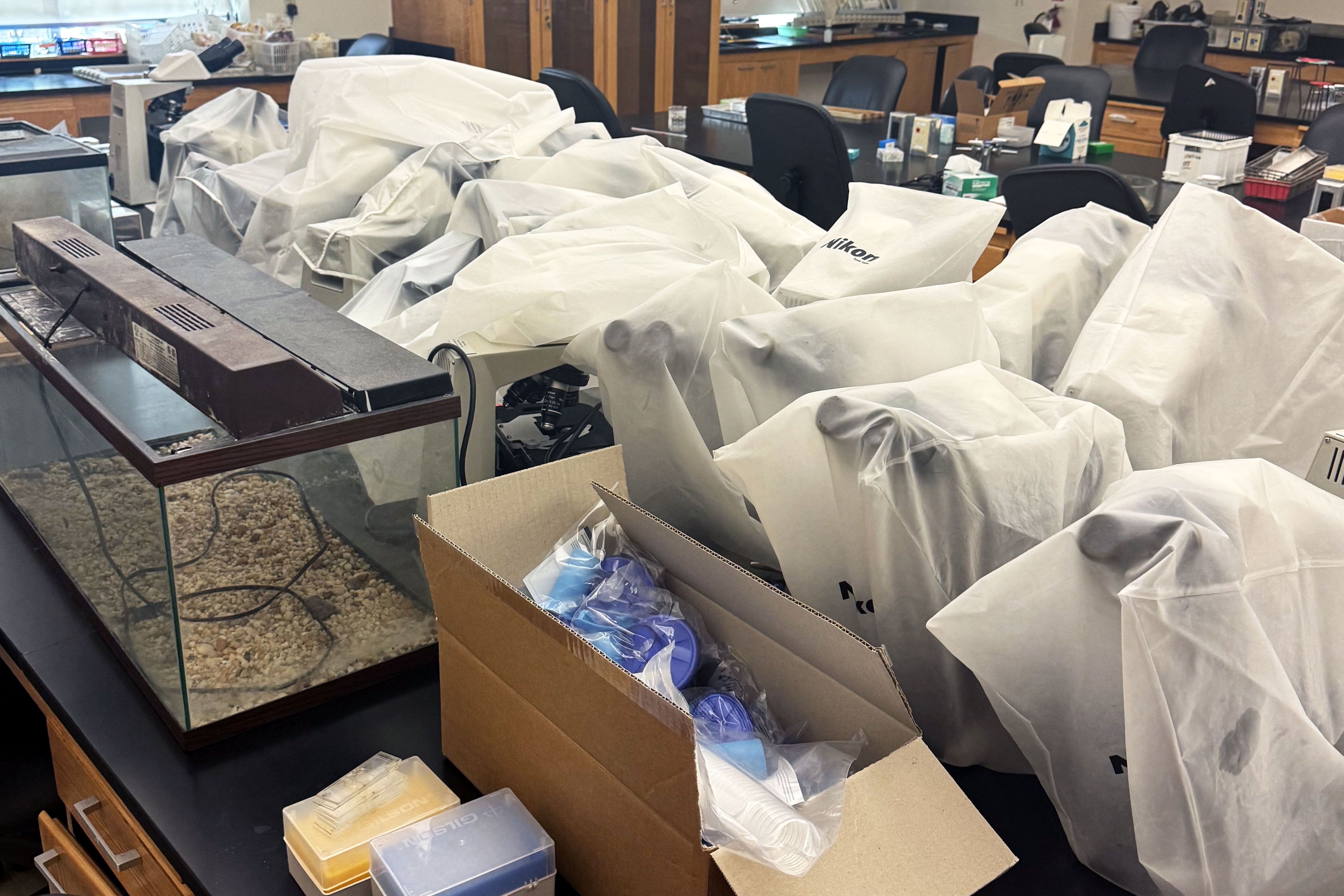

Source: Abandoned furniture and lab equipment left on campus grounds. (Muyang Cao/9fin)
Lalli’s team has been liquidating the campus parcel by parcel to offset those expenses. In 2025, the University at Albany acquired the Centennial Hall dormitory for $12m — a figure McCoy noted was well below its estimated $30m value, but a necessary step to get “that first domino to fall.”
Hudson Valley Community College purchased the Massry Center for the Arts for $1m earlier this year. Meanwhile, Albany County retained roughly eight buildings for public use, rehousing the sheriff’s office administration and the Department for Aging.
Other reuses are smaller in scale yet immediately noticeable. Saint Rose alumna Cindy Christman opened Cindy B’s Cafe next to the Department of Aging’s new office after county officials approached her about the site. The cafe occupies the campus’s former Starbucks space, freshly redecorated by her daughter with a rose-and-bee motif.
On opening day, Christman noted that nearly a dozen alumni came through the door within the first few hours, snapping photos of buildings they hadn't seen since graduation.
"As they see things moving along, like having the coffee shop come in, it's kind of changing their understanding of the campus's future,” Lalli said.
The Reimagine Saint Rose master plan, released in November 2025 and currently open for developer bids, outlines a phased transformation of the former campus. The proposal envisions a mix of multi-family apartments, senior housing, ground-floor retail, and expanded public green spaces, all anchored by a walkable civic plaza.
Macro stress
The same pressures that forced Saint Rose to close are now squeezing tuition-dependent private colleges across the nation. Restructuring consultants interviewed by 9fin anticipate a growing wave of distressed closures and forced mergers throughout the higher education landscape in the coming years.
At the root of the crisis is the demographic’s enrollment cliff. US birth rates peaked in 2007 before dropping off sharply following the 2008 financial crisis, according to CDC data. Eighteen years later, that decline has translated into a steep, structural reduction in the traditional college-age population — a trend compounded by a post-Covid shift among high school graduates opting out of higher education altogether.
Exacerbating these demographic challenges is a rigid cost structure. Unlike traditional corporations, higher education institutions cannot easily downsize operational expenses on short notice.
"Think of colleges and universities as barges or cruise ships," FTI’s Harding said. "They can go straight, but to try to turn around is difficult. You've got big campuses, big buildings, you've got tenured professors. So as enrollment declines, your cost base doesn't necessarily decline to match. You're seeing pretty large structural deficits."
Recent changes in federal policy have further tightened financial pressures on student funding. A gainful-employment framework that went into effect this summer revokes federal aid eligibility for any academic program who graduates fail to out-earn individuals without the credential. Separately, new federal caps on graduate nursing loans have been set at $40,000 — well below the tuition costs of many graduate nursing programs.
"There's going to be a lot of academic programs that college universities offer that are not going to be eligible for federal student aid," said Neil Lefkowitz, an M&A partner at Loeb & Loeb with significant experience in higher education transactions.
Distress activity remains largely concentrated in the private sector, according to Kevin Cavanagh, a higher education consolidation consultant at HCS Strategy. While public institutions face identical demographic drops and financial pressures, Cavanagh noted they benefit from three safety nets that private colleges lack: direct state operating subsidies, unionized workforces that lobby lawmakers for funding, and strong political pressure to keep public campuses open.
“They’re going to throw fewer life preservers to those private institutions, really pushing [them] to work more closely with each other — i.e., merger,” Cavanagh said.
What sets these restructurings apart from corporate bankruptcies is the ultimate outcome. While a corporate typically reorganizes under Chapter 11 and continues operations, bankruptcy is almost always a death sentence for a college. Filing Chapter 11 does not legally require an institution to close, but re-accreditation following bankruptcy is an arduous, multi-year process that advisors view as virtually impossible. Losing accreditation instantly strips the college of its Title IV federal financial aid eligibility, severing its primary revenue stream.
Given those stakes, market observers argue that proactive, strategic mergers — executed well before debt covenants and accreditation timelines exhaust a school’s runway — will become the default strategy.
Saint Rose now stands as a cautionary tale for the sector. Three years after its closure, former students and faculty have found new homes, and city planners are mapping new uses for its facilities. But certain losses remain permanent, beyond the reach of any redevelopment plan.
Filho graduated in spring 2026 and is now pursuing an MBA at Russell Sage. Last winter, he returned to the Saint Rose campus to work a Russell Sage volleyball game held in the gymnasium, which the land authority continues to lease out.
Before the match, he walked through the grounds he had not visited in over a year. He paused outside the library where he studied as a freshman — the spot where he and his friends, newly arrived in Albany and the US, had first stood together admiring the beautiful campus they thought was theirs. Tears welled in his eyes as the memories came rushing back.
"The building is here," he said, "but where's the people?"