Weil’s collapse happened in an instant. Its liquidation may take years.
Employees at Weil Gotshal & Manges learned last week that their 95-year-old employer would shut down over the course of a 30-minute Zoom call. But the long task of winding down one of corporate America’s most powerful corporate law firms will take much longer — and how exactly that wind-down occurs will depend on a number of factors, including whether it happens inside or outside the courtroom.
Until last week, Weil ranked among the most powerful law firms in the world. Its clients included Apple, PepsiCoand ExxonMobil, and it employed more than 2,000 employees in 16 offices across the world, from Silicon Valley to Brussels to Hong Kong. Weil shocked the business world when it said it would shut down following a string of high-profile partner departures that continued until its future became untenable.
Weil’s leaders said the firm will close by the end of the year, but that’s just one of the first steps. The announcement kicks off a process that advisors, lawyers and consultants said could drag on for years — adding new significance to Weil’s sprawling collection of assets and liabilities, which include leases on some of the most iconic corporate real estate in the U.S.
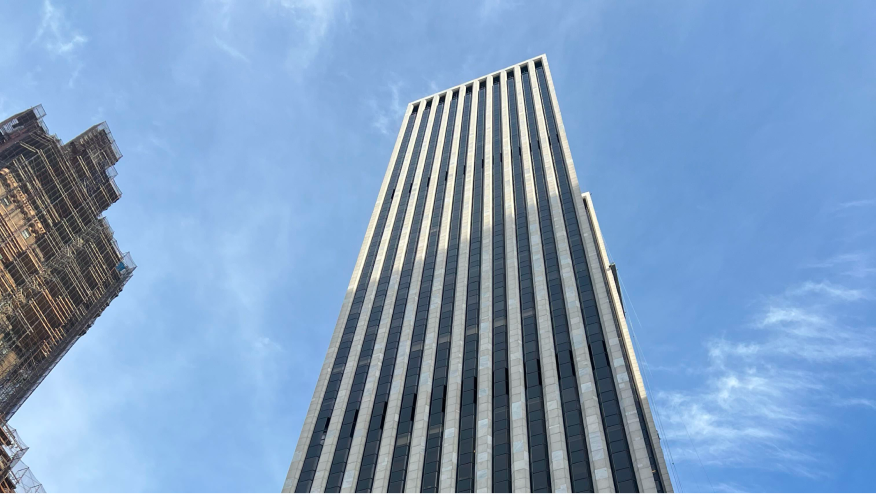
The largest of those leases is at Manhattan’s 50-story General Motors building, Weil’s global headquarters for more than 60 years, covering 450,000 square feet at $54m per year. Inside Weil’s offices are the minutiae that will also need to be disposed of: chairs, desks, and coffee machines.
“The big action happens in the first two to three years,” said George Abodeeley, a consultant involved in the largest-ever law firm closures, including the liquidations of Dewey & LeBoeuf and Heller Ehrman. “But Brobeck [Phleger & Harrison LLP] didn’t wind down for 9 years, because there is always going to be stuff that is trailing.”
Weil’s potential asset pool
Weil’s most valuable assets are its people. Unlike a manufacturer, corporate law firms sell advice, a job requiring little more than people, computers and leased office space.
In theory, that would make the money clients owe for the services provided — categorized as accounts receivable — the next most valuable asset, even after the collapse. Law firms are typically paid between 45 and 60 days after the work they do for clients, several sources said. Although it is standard accounting practice to record receivables as current assets, and Weil’s receivables are among its most valuable assets, until those bills are paid, receivables are also likely to be among the firm’s least liquid assets.
It is rare for law firms to collect on everything they bill. Clients typically pay about 80% of what law firms charge, sources said, a figure that has declined in recent years as billing rates surge and clients request more discounts. In the case of a liquidation, that number drops further. Sources said clients may resist payment at first. If their lawyers move to new firms, clients are likely to take their time to ensure they do not pay for the same work twice.
But Weil’s former lawyers will have reason to help collect. “Attorneys are motivated to pay the old law firm because they don’t want a bankruptcy trustee knocking on their door,” Abodeeley said. “It is in the attorneys’ best interest to get their old bills paid.”
Still, Weil restructuring advisor AlixPartners is likely to push for a rate between 60 and 70 cents on the dollar, a source said. The collected pile will be used to cover the firm’s liabilities.
Another potential source of assets for Weil’s estate — depending on Weil’s solvency status — could include claims against its own partners, who hold equity ownership of the firm. In previous cases, such as Dewey, law firm creditors and bankruptcy trustees have used Chapter 11 bankruptcy to accuse partners of fraudulent transfers, preferential transfers, and unfinished business, despite their being shielded from general personal liability for the firm’s debts, Yale Law School professor John Morley wrote in the 2017 article “Why Law Firms Collapse.”
“Because partners are owners of their firms, they face crushing personal liability when a firm finally dissolves. All the compensation partners receive in the months leading up to bankruptcy can be clawed back as a fraudulent transfer, for example, and the partners’ capital investments in a firm can be taken away as well,” Morley said. This is because if a firm is insolvent, especially if it was insolvent for years prior to a collapse, then any profits distributed to partners during that period of insolvency, could be characterized as fraudulent transfers.
On the other hand, in the event that Weil is considered solvent, partners may get some of their equity contributions back — though it is considered unlikely even in the event of solvency that partners will see meaningful equity contributions returned, according to one source. A silver lining is that this loss of equity may be used as a tax write off.
Weil’s liabilities
Chief among Weil’s potential liabilities are its pricey office leases. The firm has 17 offices worldwide, including 10 in the US, six in Europe, and one in Hong Kong.
The lease for its offices in the General Motors Building runs through 2034. Nonetheless, the deal was signed at a below-market rate, according to KBRA. The below-market rent could make the space easier for Weil’s landlord — BXP — to re-lease, potentially limiting Weil’s exposure.
But whether the landlord must try to find a replacement tenant is a separate question. In New York, the statutory duty to mitigate generally applies to residential, not commercial, leases. New York legislators have introduced bills to change this, but they have not yet been passed. Still, according to sources, lease terms governing mitigation after a default or early departure are often heavily negotiated, making it unlikely that Weil would be liable for the full remaining term.
Weil also is one of the biggest tenants for Boston’s Lyrik building in one of the city’s most fashionable neighborhoods: Back Bay. The firm pays nearly $77 per square feet for the 45,000sf space, a lease which ends in 2037. And in Los Angeles, Weil leases 13,000sf of space at a building in Century City.
Check out 9fin’s analysis on how the lease liabilities would stand if Weil ever chose to declare bankruptcy.
Weil’s employees and partners also participated in defined-benefit retirement plans — a rarity in corporate America and a potential source of liabilities.
Most of its corporate pension funds are well funded and do not show shortfalls, according to documents filed with the Department of Labor. For example, one of the partners’ pension funds reported $356.6m of assets at the end of last year and was 110% funded.
That reflects a broader trend: higher interest rates and rising asset values have helped fully fund corporate pension plans in recent years.
Sources noted Weil was one of the few law firms to still retain a pension fund for its partners, and was seen as a form of deferred compensation and a way to retain talent.
The company also has a revolving credit line. To bridge the gap between client work and payment, law firms typically draw on these facilities early in the year to cover daily expenses, then repay them as payments come in throughout the year.
Winding down the firm also means handling more mundane tasks, such as selling office equipment at auctions.
The case of Dewey could also be instructive: after the bankrupt law firm agreed to foot part of the bill for destroying old client files, costing them close to $1.4m. Dewey’s vendors famously repossessed the firm’s photocopiers after realizing they would no longer be paid.
In court, or out of court?
Stroock & Stroock & Lavan and Dewey are the two law firms that best provide precedent for Weil — with Stroock perhaps being a better parallel given the catalyst for the wind-down was partner departures and there is no report of any fraud. Stroock voted to dissolve on 31 October, 2023, after major partner departures, similar to Weil. Stroock also implemented the same timeline as Weil, and officially ceased practicing law on 31 December, 2023. The firm completed its out-of-court wind-down and asset liquidation as of 31 December, 2025.
Dewey’s wind-down, serves as a contrast for Weil — given that Dewey’s collapse was precipitated by $245m in debt partially as a result of funding multi-million-dollar guaranteed compensation contracts and target payouts for “rainmakers,” as well as a multi-year accounting and financial fraud scheme. Dewey began discussing a possible wind-down in April 2012, before ultimately filing for bankruptcy on 28 May, 2012, and having a plan of liquidation approved on 27 February, 2013.
Most law firms tend to try and dissolve out of court but as time goes by, filing for bankruptcy could allow for a neater and swifter resolution, said Abodeeley.
He noted of the 10 largest bankruptcies, two were done successfully out of court.
“It’s sad to see, but unfortunately, there are too many things going on opposed to each other. …You want to try to keep it out if you can, but sometimes you really don’t have a choice,” said Abodeeley.
Many of the law firms that chose to dissolve and later filed for bankruptcy were struggling for years. Weil, by contrast, was by no means considered a struggling firm, having generated nearly $2.1bn in 2025 and averaging between $5-6m per partner. The firm may still have been generating a strong profit margin this year — even with the departures, and the potentially large business that partners took with them.
Unlike Dewey, Weil is not known to have had any liability through guaranteed compensation contracts for “rainmakers” — in fact, this was part of Weil’s problem since Weil’s rainmakers were generating big profits and when they left, they were expected to take many lucrative business accounts with them. Therefore, as long as Weil can manage to pass on its leases, it is very possible that Weil could keep its wind-down out of court.