This is part of 9fin’s special report looking at financial distress and M&A in American higher education. Read more here.
1. Harrisburg University, Harrisburg, PA
- LTV: 70% (Debt/Gross PP&E)
- Endowment: $1.6m
- Liquidity: $8m
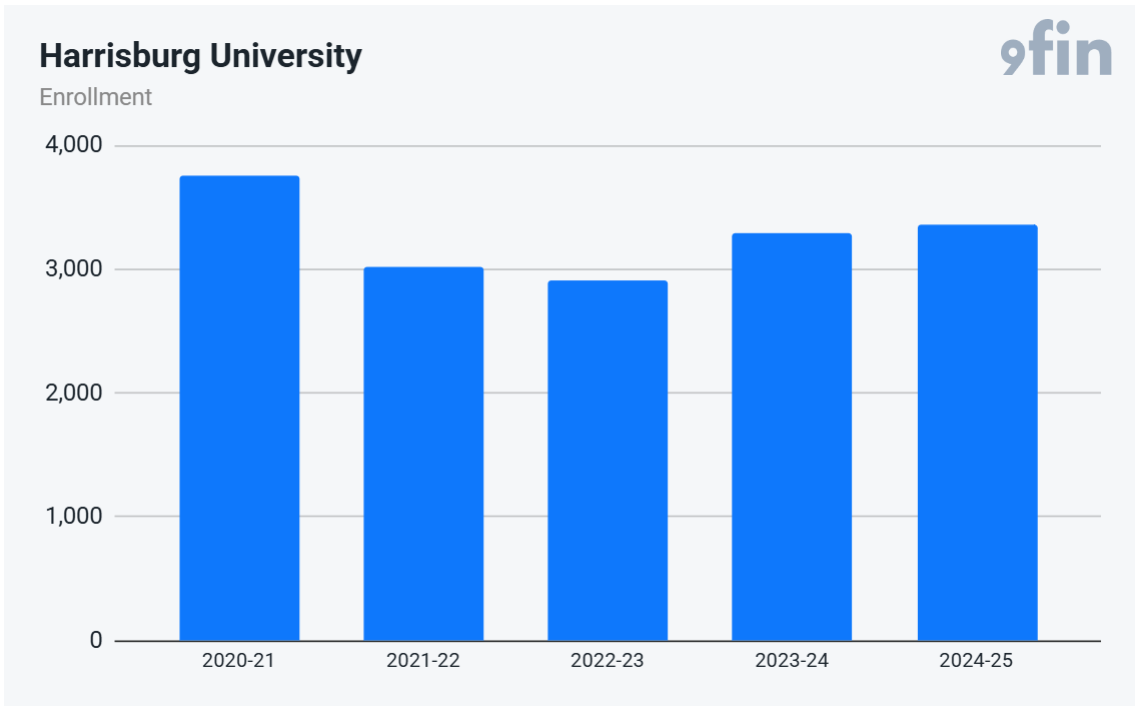
Harrisburg University is a private, STEM-focused institution renowned for its industry-aligned experiential learning, key strengths in computer science, cybersecurity, and data analytics.
In April, S&P Ratings placed Harrisburg on a negative outlook and downgraded their $74m bond to CCC+ after they missed an interest payment on bonds. That debt was issued to finance a 14-story downtown tower the university started building before the Covid pandemic. The tower never reached full capacity, which led to a significant deterioration in Harrisburg’s finances. It undertook various initiatives, including reducing full-time faculty to 92 from 139, saving $34m in expenses.
The university has inadequate liquidity to pay its $10m in interest for FY 26, as it only has $8m in cash and equivalents. Revenue is slightly up YoY to around $80m in FY 25 with expenses declining 9% YoY to $81m in FY 254.. The employees and faculty accepted a reduction in pay in 2025 to allow for the university to continue operating.
Notably, student housing generates under $1m in revenue, resulting in a lower liquidation value for the campus as student housing is often the most monetizable asset in a university liquidation. Additionally, the quality of the campus seems to be deteriorating. D&A is $7m, but capital expenditures only amount to $0.5m for FY 25. The school has $143m in bonds outstanding and $19m in mortgages. The bonds are under “Dauphin County General Authority University Revenue Bonds Series Of 2020” and were issued for the “construction and development of land” and “refund debt.”
There is a $4m maturity in 2026, with the longer-dated bonds currently trading at 23. In addition, it has a $1.6m endowment fund and $10m in donations from alumni not earmarked for specific purposes. Those funds could be used for interest payments.
Governance concerns can also be raised as Eric Darr, the former president, was paid $600k and COO, Duane Muan $500k in FY 25 which is above typical wages for similar roles. They have also provided a $7m loan to an affiliate in Dubai that serves as their international campus. A recent article also noted that graduate enrollment at Harrisburg is up for the upcoming academic year which might support revenues but the larger turnaround is still required.
Sources
https://emma.msrb.org/IssueView/Details/P1408176
2. Jessup University, Rocklin, CA
- LTV: 70% (Debt/Gross PP&E)
- Endowment: $7.3m
- Liquidity: $5m
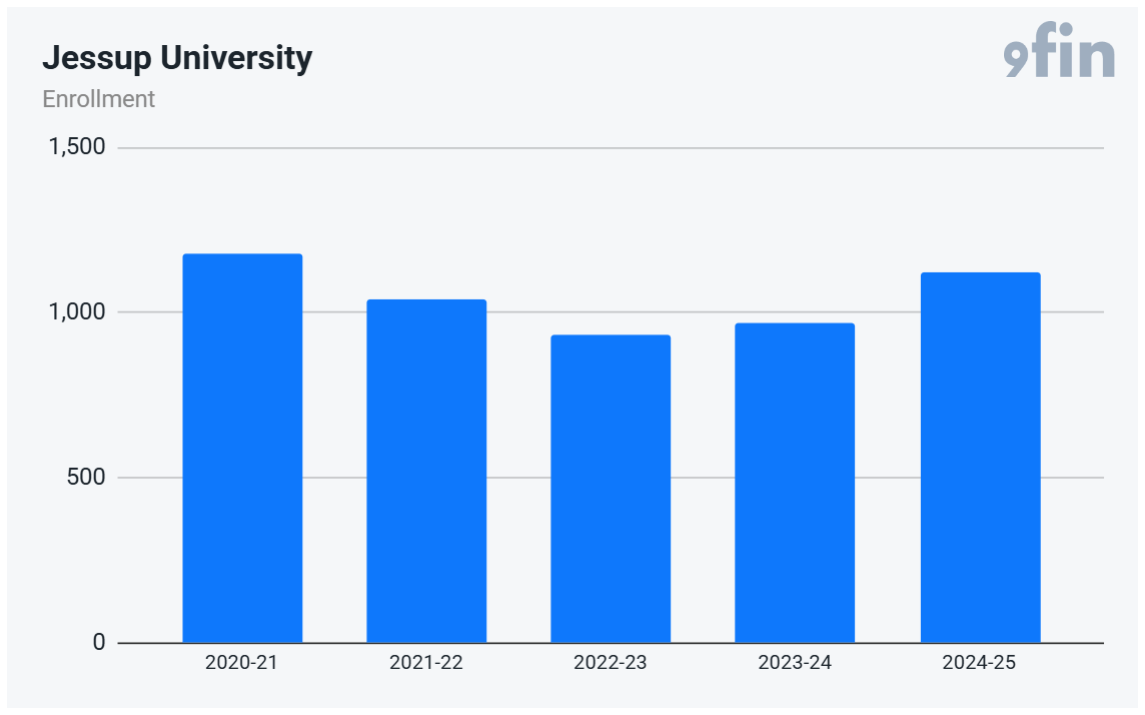
Jessup University is a private Christian university offering Christ-centered liberal arts and professional degree programs, featuring strong offerings in business, psychology, and computer science alongside a robust NAIA athletics program.
William Jessup extended their bankruptcy timeline in 2023 by effectively merging with distressed Multnomah University and securing a $30m loan against the acquired campus to pay an upcoming coupon payment on the about $100m in bonds they had out at the time. As conditions worsened, Jessup closed Multnomah’s Portland, Oregon campus, moved students to online school and laid off all personnel.
However, the negative financial trajectory has continued. Revenue declined 21% YoY to $62m due to reduced grants and lower enrollment which reduced 15% YoY. Expenses increased 33% to $85m from $64m YoY due to increased employee-related expenses. Interestingly, the founder/president of the board gave a $900,000 loan to fill a “temporary operating cash flow shortfall” shortly after which he stepped down from his position. Various governance shortcomings are also persistent with business transactions involving interested persons totaling about $542,000.
Jessup has $79m in bonds outstanding under “California Municipal Finance Authority” which is currently quoted at 69 with a coupon of 5.5% and coming due in August of 2027. Out of the 3 segments (Traditional & Degree Completion, Graduate Education, and Online Education), the latter is the most profitable with a margin of 70%, but contributes just under $2m in revenue which may not stick. The largest segment is the 1,000 person undergraduate school with $49m in revenue, but a staggering $72m in expenses propels cash burn to over $8.5m. With a current cash balance of $5m, the university is set out to run out of liquidity by the end of this year. The endowment fund consists of about $7m with a negative contribution trend and assets that are earmarked for specific purposes.
Recently, the university got a $2m loan from the former Intel CEO Pet Gelsinger, an alumni of the university, secured by the Clover Valley property which was placed under a permanent conservation easement in 2025. With a coupon payment upcoming and limited liquidity, future M&A could be on the horizon.
Sources:
https://projects.propublica.org/nonprofits/organizations/941279803/202601349349303940/full
https://sacramento.newsreview.com/news/a-university-at-a-crossroads-66e77568
https://www.sacbee.com/news/local/article316848745.html
3. Ohio Dominican University, Columbus, OH
- LTV: 53% (Debt/Gross PP&E)
- Endowment: $21m
- Liquidity: $6.5m
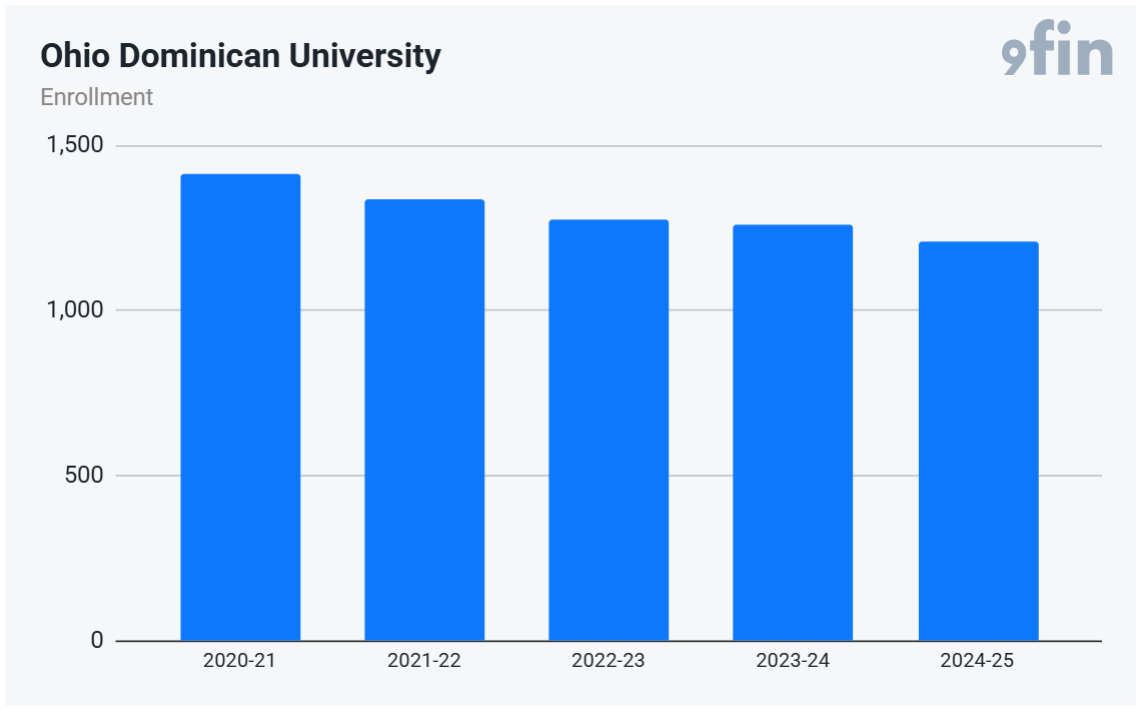
Ohio Dominican is a Catholic liberal arts university with notable health science programs (including physician assistant and anesthesiologist assistant studies) and a strong athletics presence.
The school missed their last $1.6m bond payment due on March 1, 2026 and had to ask bondholders to draw on a reserve fund to make their interest payment on September 2, 2025.
Revenue declined 7% YoY to $44m in FY 25 from $48m in FY 24 due to fewer contributions and grant-related revenue. However, expenses stayed flat YoY at $49m. It has an interest payment of $3.3m due this year and has about $6.5m in cash on hand. The condition of their campus is also deteriorating, as it recorded $2.5m in D&A last year compared to only $1.1m in capital expenditures.
They have $49.5m in bonds outstanding under “Columbus-Franklin County Finance Authority” which was quoted at 58 at the time of publishing. The bonds have a relatively high fixed coupon of 6.5% which make the trading price of 58 mostly attributable to lower expected recovery on collateral rather than lower yield. One explanation is that the underlying real estate collateral are highly specialized science and sports facilities making recoveries very low as few buyers are interested in trying to repurpose those buildings. Moreover, the university houses 456 students at a cost of about $10m against which it collects only about $6m in revenue. This pressures recoveries, as student housing is usually the highest-recovering asset in university liquidations.
Ohio Dominican also has a $21m endowment fund, but 67% of it is permanent, making it unavailable to pay debtor claims. The missed bond payment should expedite any M&A or asset sales.
Sources
https://emma.msrb.org/Security/Details/A590EB80AA08F919C53196E90C99AE775
4. Rider University, Lawrenceville, NJ
- LTV: 65% (Debt/Gross PP&E)
- Endowment: $90m
- Liquidity: $9m
Rider is a private university known for its robust business administration, education, and performing arts programs - notably home to the renowned Westminster Choir College - supported by competitive NCAA Division I athletics.
Rider lost its accreditation status at the beginning of the year but gained a temporary “non-compliance probationary status” in June from the Middle States Commission on Higher Education. The temporary status is a result of the completion of its turnaround plan which involved laying off 35 faculty members, wage cuts of about 10% for staff and faculty, and selling 90 acres of land to Mercer County. The university’s leadership expects to break even in FY 27 as it improves operations and pays down debt.
Revenue is up 4% YoY to $199m from $191m and expenses are down $6m to $207m. However, revenue increased due to a $5.5m gain in non-recurring investment income. Rider's cash burn rate slowed to $9m from $14m the year prior, but its liquidity is barely enough to cover its $7.3m interest payment. However, the university recently paid down $20m of debt unrelated to their bonds, which should reduce interest expense.
A bright spot is its student housing which brought in $30m last year at an expense of $25m, leading to a net operating income of $5m. The university’s capex is $2.2m against $11.5m in D&A, indicating that the condition of their campus is worsening over time. Rider’s assets include PP&E worth $115m and a $90m endowment fund. The endowment fund has 14% of its AUM in illiquid private equity LP stakes. They have three bond issues totaling $108m under “Public Finance Authority” and “New Jersey Educational Facilities Authority” issued in 2016, 2017, and 2021.
The 2016 $31m bond was issued to “renovate space within the science and technology building” and the 2021 bond contributed $40m in capex out of which 25% went to Mike and Patti Hennessy Science and Technology Center which will affect recoveries as potential buyers could be less likely to buy a specialized building that are difficult to repurpose. In addition, Rider boasts over 20 Division 1 sports teams which require massive athletic infrastructure, for which few buyers exist as well. Out of the whole campus, student housing is the only readily sellable asset but won’t be nearly enough to pay par for the bonds.
Rider’s accreditation is premeditated on its continued turnaround execution, which requires significant debt paydown. As the school is currently losing money, it is likely that debt paydown will continue to be funded by asset sales.
Sources
https://theridernews.com/rider-slashes-debt-to-gain-financial-stability/
https://www.rider.edu/support-rider/areas-to-support/capital-projects/science-building-renovation