
This is part of 9fin’s special report looking at financial distress and M&A in American higher education. Read more here.
Legal architecture and framework
Distressed university M&A almost never happens in bankruptcy court, and that’s not an accident. The entire toolkit that defines corporate distressed deals — Chapter 11, 363 sales, DIP financing, credit bidding, cramdown, discharge — is functionally unavailable to degree-granting institutions.
What looks at first glance like two variations on distressed dealmaking is two entirely different legal regimes, driven by one statutory provision buried in the Higher Education Act.
Section 102 of the Higher Education Act, as amended in 1992, provides that an institution loses Title IV eligibility upon filing for bankruptcy — immediately and irrevocably. Title IV is the lifeblood of most colleges and universities: it authorizes federal student loans, Pell Grants, and work-study funding. Congress added this provision in 1992, largely in response to for-profit-college abuses of the era. Its practical effect is more sweeping than the legislative history suggests. Because roughly 85% of students rely on Title IV to pay tuition, a Chapter 11 filing is functionally a liquidation event for a degree-granting institution, not a reorganization tool.
The provision is also irrevocable in a way most bankruptcy practitioners would find jarring. There is no cure, no reinstatement mechanism, and no discretion vested in the US Department of Education (ED) to waive it. Even if an institution emerged from Chapter 11 with a clean balance sheet, sophisticated management and full accreditor support, it would remain permanently barred from Title IV as long as the filing entity — or its controlling affiliate — remained in the ownership chain.
A 363 sale offers a theoretical escape hatch: the debtor files, sells the operating assets free and clear to a new entity that never filed, and the buyer applies for its own Title IV certification. In practice, the acquirer faces a re-certification process that can stretch a year or more, with ED historically imposing provisional certification, heightened cash monitoring and letter-of-credit requirements on post-bankruptcy purchasers. For an operating college, even a partial interruption of Title IV cash flow during that window is often indistinguishable from liquidation.
That single regulatory feature drives virtually every structural difference between the two markets. Distressed higher-ed M&A is corporate M&A, but with the bankruptcy toolkit removed and a heavier regulatory overlay in its place.
What fills the bankruptcy vacuum?
Because bankruptcy is not a realistic option, distressed higher-ed transactions are done through a patchwork of corporate, nonprofit, and regulatory mechanisms borrowed from the M&A world rather than the restructuring world. The main structural options are:
- Statutory merger: The two institutions merge under state corporate or nonprofit law, with one as the surviving entity. This is the cleanest path and the one Elon-Queens University of Charlotte and Russell Sage-Albany College of Pharmacy are following. It requires board approvals on both sides, regulatory sign-off (discussed below), and for public universities, state legislative authorization
- Membership substitution: For nonprofit institutions organized as membership corporations, control can transfer by substituting the sole corporate member. The target institution's legal shell survives, but the parent-level control shifts. Rosemont-Villanova and Ursuline–Gannon are structured along these lines. Membership substitution is attractive because it can preserve the target's separate accreditation, tax-exempt status, and existing contracts while accomplishing effective change of control
- Asset purchase: The buyer acquires specific assets – real estate, intellectual property, program approvals – without assuming the seller's corporate shell. The California College of the Arts-Vanderbilt University transaction, in which Vanderbilt is acquiring and repurposing CCA's campus in San Francisco while CCA winds down, is closer to this model. Asset deals are common when the buyer wants the real estate but not the institution
- Teach-out agreement: Where no going-concern buyer emerges, an accreditor-approved teach-out lets a partner institution absorb enrolled students and honor their credits. This is not an M&A transaction in the traditional sense, but it functions as a de facto asset transfer of the student roster and often precedes a real estate or IP sale to the same partner
None of these mechanisms produce the two features that make Chapter 11 uniquely powerful in corporate distress: a discharge of unwanted liabilities and the ability to bind dissenting creditor classes through cramdown. That absence shapes every downstream feature of the market. Buyers demand indemnification packages and reps-and-warranties survival that would be atypical in a 363 context, because the "free and clear" order that cuts off most successor liability claims in bankruptcy is unavailable outside it. Sellers cannot cram down holdout municipal bondholders — a critical constraint given how much small-college debt is tax-exempt paper with strict consent requirements. And unsecured trade creditors have no formal committee mechanism to organize a collective voice, which usually means they either negotiate one-off or get paid at whatever level the buyer and secured lenders decide is sufficient to close.
Universities face a much higher regulatory overlay
Corporate M&A answers primarily to two regulators: the antitrust authorities (DOJ or FTC, plus CFIUS where relevant) and, for public company deals, the SEC. Distressed university M&A answers to a substantially longer list, and each approver holds an effective veto:
- The US Department of Education (ED): ED conducts a pre-acquisition review under 34 CFR Part 600 whenever there is a change in ownership or control. The review covers financial responsibility (if the surviving institution meets ED's composite score thresholds), administrative capability, and critically, the terms of any debt assumed to finance the transaction. Under the ED final rule which took effect 1 July 2024, the Department can deem an institution not financially responsible after a change in control if the debt assumed to complete the acquisition requires payments inconsistent with available cash. That gives ED an effective say over deal financing structure, not just deal approval
- Regional accreditors: Every degree-granting institution is accredited by one of the regional accrediting bodies or a specialized accreditor for certain disciplines. Any substantive change requires accreditor approval, typically involving a substantive change application, site visit, and board vote. Accreditor timelines rarely track deal timelines and can extend a transaction six to twelve months
- State education agencies: Most states require separate approval from the state higher education authorization agency for any change in institutional control, and unlike the federal and accreditor layers, there is no unified national standard. Each of the 50 states runs its own review criteria, timeline, and appeal process. New York's Board of Regents is unusually powerful because New York directly charters its degree-granting institutions rather than delegating to accreditors, and Regents approval is required for any merger, change of control, or asset transfer. This process routinely takes six to twelve months and comes with substantive conditions on governance and academic programs. California's Bureau for Private Postsecondary Education runs an equally involved change-of-ownership review, with heightened financial and consumer-protection scrutiny
- State attorneys general: For nonprofit institutions, the state AG has authority over dispositions of charitable assets. AG approval — or at least non-objection — is required to transfer endowment funds, restricted gifts, and real estate held for charitable purposes. This is one of the most underappreciated deal risks in the space: an AG who believes donor intent is being violated can hold up or reshape a transaction
- Governors and legislatures: For public university transactions, the governor and often the state legislature are direct parties. The merger of New Jersey City University and Kean University required New Jersey Governor Phil Murphy to sign enabling legislation in January 2026 before the July 2026 effective date. This is not the equivalent of a state antitrust filing but rather direct political control of the deal
- Bondholders: Many small colleges carry tax-exempt municipal debt, often through state education finance authorities. Bond indentures typically require bondholder consent for merger, sale, or transfer of pledged assets. Unlike in Chapter 11, there is no cramdown mechanism; blocking position genuinely blocks
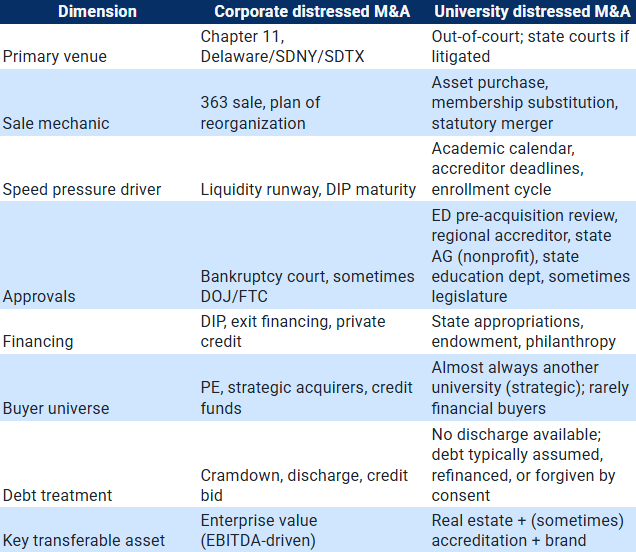
The cumulative effect is that a distressed university transaction runs through six or seven approval bodies, each with independent standards, timelines, and constituencies. A corporate 363 sale can go from petition to closing in 60 days. A university merger routinely takes 12 to 18 months from letter of intent to effective date — the Ursuline-Gannon timeline (LOI September 2024, definitive agreement January 2025, change of control June 2025, full merger targeted December 2026) is representative.
The table below summarizes the key differences between these transaction domains:
Moving faster
The legal architecture described above has produced a market that university leaders, restructuring advisors, and increasingly, federal policymakers all view as broken. Deals that should take months take years. Institutions that could be saved close instead. Buyers who would provide rescue capital cannot enter the market. In 2026, that consensus has begun to translate into concrete policy movement, most visibly from the Department of Education itself.
Nicholas Kent, confirmed as Under Secretary of Education in August 2025, has become the administration's most vocal proponent of streamlining higher-ed M&A. Speaking at a summit at George Mason University in March 2026, Kent said the Department aims to begin “regulating on this either later this year or early next year” in an effort to “make it easier for these conversations to happen.” He returned to the theme in late June at the NASFAA annual conference, telling attendees that “we need to make this process of consolidations, mergers and acquisitions— even closures — a lot easier for institutions,” and acknowledging that some of the changes would require new regulations rather than sub-regulatory guidance.
In a May 2026 Bloomberg interview, Kent framed the case in explicitly transactional terms: “[w]e've made it increasingly complicated and really time-consuming for institutions to enter into these partnerships. We need to be facilitating a process that moves a lot quicker.” The agency aims to expedite and simplify M&A reviews within the next year in a timeline that, if met, would put new rules in place before the demographic cliff hits its trough in 2029.
The immediate policy target is the ED final rule, effective July 2024, which imposed new financial responsibility standards, joint-and-several liability for controlling owners, and heightened pre-acquisition review of buyer finances on change-of-ownership transactions. Kent has also flagged older procedural requirements as decades-old hurdles that can jam up a transaction for months. The Northeastern University acquisition of Marymount Manhattan College is a case that keeps getting cited: final approval is expected more than two years after the initial announcement, and the lag partly reflects a long federal regulatory process.
The private capital question
For a restructuring and private credit audience, Kent's agenda is the door it may open for financial buyers. Under current rules, ED's financial responsibility standards, change-of-ownership review, and, for any transition through for-profit ownership, the 90/10 rule — a federal policy that no more than 90% of a school’s budget can come from federal sources — creates enough friction that PE firms have effectively abandoned nonprofit higher ed as an acquisition target. Jonathan Helwink, a higher-education lawyer who served in the first Trump administration, put it bluntly to Bloomberg: “[p]rivate equity is and was interested in higher ed institutions, but the requirements the department imposed made ownership of a college by a PE firm essentially impossible.” Kent said changes to the oversight process would likely open doors for those frustrated investors.
If ED follows through, the sector's buyer universe expands for the first time in a decade to include financial sponsors, credit funds, and potentially the same distressed-debt and special-situations investors who dominate corporate restructuring. It does not eliminate the Higher Education Act's anti-bankruptcy provision, but it makes the out-of-court M&A pathway meaningfully more accessible to non-strategic buyers. The knock-on effects for private credit could be substantial: rescue financing structures, receivables-based lending, real-estate-anchored takeouts, and OPM-style joint ventures all become viable in ways they aren't today.
The counter-case: all smoke, no fire
Kent's agenda has broad support from university leaders and the strategic-buyer community, but the political coalition around it is unstable. Consumer advocates, teachers' unions, and Democratic policymakers point to the Corinthian, ITT Tech, and Education Management collapses as evidence that loosening ownership review invites the kind of profiteering that leaves students with defaulted federal loans and worthless credentials. Any rulemaking will draw comment-period pushback framed around student protection, and the more expansive the rewrite, the more litigation risk it carries. The Biden ED's own rulemaking history — several of its regulations have been vacated or narrowed in federal court over the past two years — cuts in both directions here: it makes Kent's rollback easier to justify, but sets precedent for the next administration to reverse course again.
The market implication is that any regulatory framework produced in the next year will not be stable. Buyers and sellers will have to price political durability into deal terms, and lenders financing higher-ed transactions will want covenants and material adverse change provisions that account for regulatory reversal.
The deeper question: Title IX eligibility
Kent's proposals operate within the existing statutory framework. They do not touch the underlying provision: 20 U.S.C. §1002, the 1992 amendment that strips Title IV eligibility from any institution that files for bankruptcy. That provision is the reason distressed higher-ed M&A exists as a separate market from corporate distressed M&A in the first place, and it remains politically untouched.
A decade of legal scholarship has argued that the 1992 anti-bankruptcy provision has outlived its rationale. The original concern — for-profit institutions using bankruptcy to escape federal loan obligations — has been substantially addressed by intervening reforms to ED's financial responsibility rules, borrower defense to repayment, and gainful employment regulations.
Academic proposals have coalesced around the idea of a higher education-specific bankruptcy subchapter, modeled loosely on Subchapter V for small businesses or Chapter 9 for municipalities. It would allow Title-IV eligibility to survive a filing under defined conditions: continued accreditor oversight, a court-approved teach-out plan for students, and constraints on ownership changes. No serious legislative push has emerged, but the intellectual case has been made in law reviews and at ABI-affiliated symposia for several years. The Kent agenda may create political space for that conversation.If the administrative path to easier M&A visibly falls short, statutory reform becomes the natural next ask.
What to watch
A few concrete items will signal whether the policy shift becomes reality.
ED's regulatory agenda publication for late 2026 or early 2027 will name the specific rules it intends to open. The change-of-ownership rules at 34 CFR Part 600, the financial responsibility rules at Part 668 Subpart L, and the 90/10 calculation rules are the three most likely candidates. A negotiated rulemaking committee— required for most Title IV rulemakings — would signal a longer runway; direct rulemaking would signal aggressiveness.
Accreditor-level movement is a parallel track. Several accreditors have their own change-of-control standards that operate independently of ED, and Kent has already sent letters to two accreditors on DEI standards, indicating he views accreditor policy as a lever ED can pull. Watch whether the regional accreditors move to shorten their own review windows.
State-level activity is the third track. States that have absorbed the largest share of distressed closures — Massachusetts, Pennsylvania, New York and Ohio — have all considered or enacted transition-funding legislation. The NJCU–Kean model, with state legislative authorization and $25m in transition funding, is likely to be copied.
Finally, the deal flow itself. If Kent's changes take effect, the market signal will be a shift in the buyer mix – the first PE-backed or credit-fund-backed acquisition of a nonprofit college would be the piece of news that confirms the regulatory environment has actually changed. Until that transaction closes, all the policy movement is prologue.
The demographic and financial pressures that drove the 2020–2025 wave of school closures and mergers are not resolving; if anything, they will intensify through the end of the decade. Whether the next wave gets absorbed by strategic buyers moving through a streamlined ED process, by financial sponsors entering the market for the first time, or by a new statutory framework that pulls the sector partially back into bankruptcy court, depends on choices being made in the next twelve to eighteen months.