
Sometimes bond terms appear in loans. Sometimes loan terms appear in bonds. However, occasionally the convergence of terms can be complicated due to different rules that apply to the two instrument types.
A “snooze or lose” provision, typically seen in term loans, has now appeared in a high yield bond. As discussed in our previous educational piece, “You snooze, you lose”, there are two facets to this provision: (i) "snooze or lose" and (ii) "delay and it's OK". The first provides that a non-responding lender's commitment is disregarded when calculating required voting thresholds for amendments; the second provides that a non-responding holder will be deemed to have voted in favor of an amendment, making it easier to achieve the required voting threshold.
As highlighted in our Legal QuickTake, the Senior Secured Notes financing Kelvion (Heat Exchangers)’s recent takeover by Apollo and Triton, which launched yesterday, contained the following provision (highlights added):
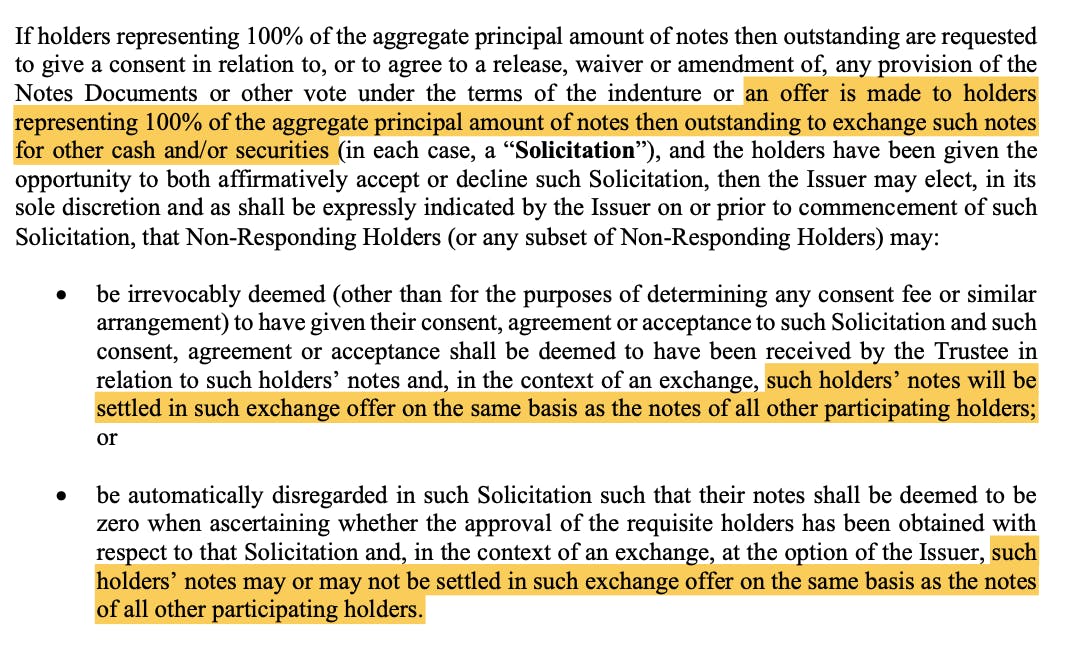
For purposes of the foregoing, a “Non-Responding Holder” is defined as any holder that has failed to respond prior to 10 business days or such other date or time as specified in the relevant documentation after being solicited.
US securities law considerations
The language highlighted above seems to suggest that holders may be dragged along after the 10th business day in any tender offer and forced to exchange their notes for cash or other debt. If so, it would seem there are securities rules applicable to scenarios like this. For example, the SEC’s Rule 14e-1 requires that tender offers remain open for a specific period of time:
... no person who makes a tender offer shall: (a) Hold such tender offer open for less than twenty business days from the date such tender offer is first published or sent to security holders …
The SEC's Rule 14e-1 applies to tender offers for both debt and equity securities, whether or not such securities are registered (see Question 161.01 of the SEC’s C&DI on tender offers, available here). Tender and exchange offers in Europe generally adhere to the requirements of Rule 14e-1 including that the offer be made to all existing securityholders, be open for a minimum duration of at least 20 business days (subject to certain abbreviated tender exceptions) and be extended after changes to certain terms.
Clearly, 10 business days is less than 20 business days. But even if the issuer in practice were to "voluntarily" keep the tender offer open for the required timeframe, we are not aware of any applicable SEC rule or guidance pursuant to which silence would be considered acceptance of a tender offer.
Other considerations
Tender offers coupled with exit consents have been market practice in high yield bonds for decades. It is important to distinguish between the rules governing the “offer” and the rules governing the “solicitation” of amendment consents. If a particular consent solicitation affects only amendments to covenants, such as an increase in the size of a particular basket, the tender offer rules sit on the sideline.
There certainly is legal authority for the permissibility of "deemed consent" provisions (including the delay/OK variety) in the amendment solicitation context. See, e.g., Restatement (Second) of Contracts § 69 (1981) (silence does not constitute acceptance, subject to certain exceptions including where “the offeror has stated or given the offeree reason to understand that assent may be manifested by silence or inaction, and the offeree in remaining silent and inactive intends to accept the offer”). However, we are not aware of any corresponding principle under applicable tender offer rules.
Beyond this, there are the requirements of the relevant clearing systems. In practice, when a noteholder tenders securities, the clearing system blocks such security. Would the clearing systems be willing to redeem or exchange notes for which they have not received an affirmative acknowledgement from the noteholder?
Conclusion
The Kelvion provisions may be an instance where the ultimate outcome reflects a commercial agreement to include flexibility in the documentation, subject to the understanding (whether expressed or implied) that it may not violate applicable laws and regulations. Should these provisions survive into the final documentation, it would be yet another example of the ever increasing alignment between bonds and loans, further blurring the distinction between the two.