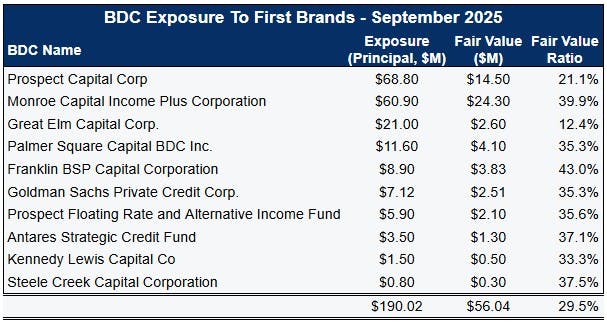
As First Brands continues its bankruptcy proceedings in Texas, business development companies (BDCs) with exposure to the auto parts supplier have collectively marked down the fair value of their investments to less than a third of their outstanding principal.
The BDCs were part of 15, which were subjects of one of our last month’s reports detailing how the collapse of First Brands sent shockwaves through the Wall Street, affecting funds that retained investments in the troubled company as of June 2025.
Scrutiny of First Brands' off-balance-sheet liabilities intensified in the Q3 of this year, coming up just after BDCs had already filed their Q2 earnings reports, in which the funds marked loans tied to the company above 89%.
As third-quarter earnings season heats up, several of the affected BDCs have begun reporting substantial losses on their First Brands holdings for the very period the repeated spotlight on the company accelerated its rapid fall into bankruptcy.
Of the 15 BDCs previously identified as holding First Brands credits in the second quarter, at least 10 have reported earnings, cumulatively showing $190m in assets mostly in first-lien senior secured loans and junior debt. In each case, the BDCs cut back the fair value marks on those First Brands positions by more than half compared to the previous quarter, according to 9fin’s data.
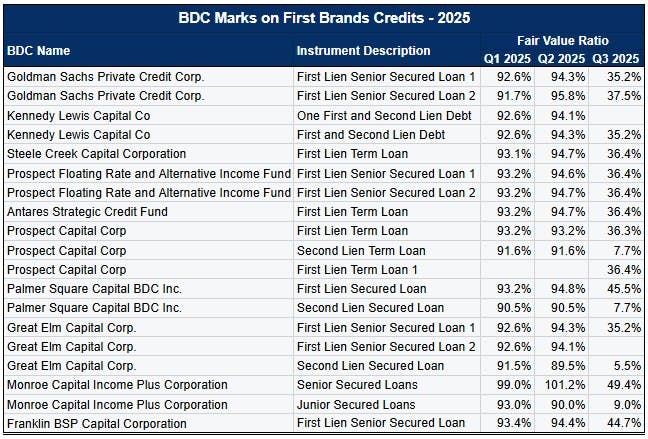
Goldman Sachs Private Credit Corporation and Kennedy Lewis Capital Company made the biggest cut on First Brands’ most secured debt. The two private credit managers slashed the fair value marks on their first-lien loans in the manufacturer from 94.3% in the Q2 to 35.2% in Q3.
The two BDCs were closely followed by Steele Creek Capital Corporation, Prospect Floating Rate and Alternative Income Fund, as well as Antares Strategic Credit Fund, all of which marked their first-lien loans in First Brands at 36.4%.
Prospect Capital Corporation, which had the largest exposure to First Brands among the BDCs, faced an even steeper writedown. It reduced the fair value of its first-lien debt from 93.2% to 36.3%. As if that’s not enough, its second-lien position took the most hits. The junior debt is the BDC’s largest component of its First Brands holdings, accounting for over 57% of its total investment. Yet, the instrument suffered the lowest markdown, crashing from 91.6% in the Q2 to just 7.7% within the three months leading up to September.
Palmer Square Capital BDC also recorded a significant markdown on its second-lien debt in First Brands. The creditor’s first-lien loan, however, was marked down from 94.8% to 45.5%, making it the highest fair value ratio among all BDCs holding First Brands senior debt.
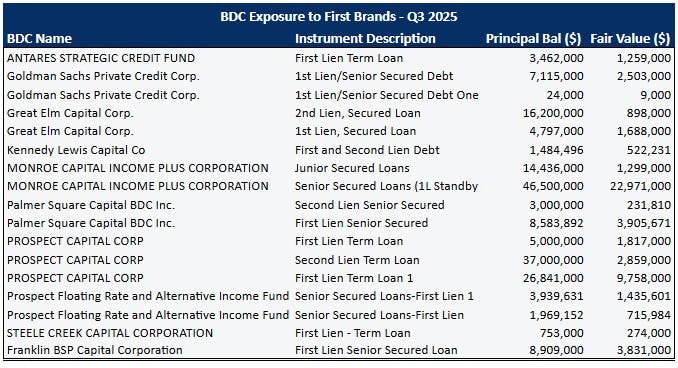
The remaining BDCs that maintained exposure to First Brands in the third quarter include Great Elm Capital Corporation, Monroe Capital Income Plus Corporation, and Franklin BSP Capital Corporation. Each of these funds held positions in the company’s senior loans, and all saw those investments sharply marked down in a similar fashion.
Great Elm Capital slashed its $4.8m first-lien position from 94.3% to 35.2% and its $15.8m second-lien loans from 89.5% to just 5.5%. Monroe Capital Income Plus, which was the only BDC that carried the automaker’s loan at a premium in the second quarter, cut the mark on the senior debt sharply to 49.4%. Finally, Franklin BSP Capital Corporation reduced the fair value of its sole credit investment from 94.4% to 44.69%.