Bonds issued by Xerox have traded down after the Wall Street Journal reported the company is actively seeking to raise a $500m loan secured against its intellectual property, to strengthen liquidity amid efforts to realize synergies from its acquisition of Lexmark.
At the time of writing, Xerox’s first and second lien notes due 2030 and 2031 were indicated at 95.7 and 81.5, respectively, compared to 99.5 and 87.1 the day before — representing declines of approximately 380bps and 560bps.
The first lien notes are secured on a first lien basis against fixed asset collateral (which generally includes equipment, intellectual property and the equity interests of the subsidiaries of the borrowers and guarantors under the TLB), and substantially all assets of Lexmark International II, LLC and certain of its subsidiaries that will secure the TLB facility — and on a second lien basis of current asset collateral (which generally includes accounts receivable, inventory, deposit accounts and cash), and Lexmark’s current asset collateral.
The second lien notes, post release from escrow, are secured on a second lien basis against fixed asset collateral and on a third lien basis against current asset collateral.
As of 30 September, the company’s liquidity seemed reasonable at around $658m, comprising $479m in cash and $179m of remaining availability under its ABL facility. However, Xerox drew down $100m under its ABL facility in the third quarter and another $50m subsequent to quarter end, potentially raising concerns that liquidity may be tighter than anticipated.
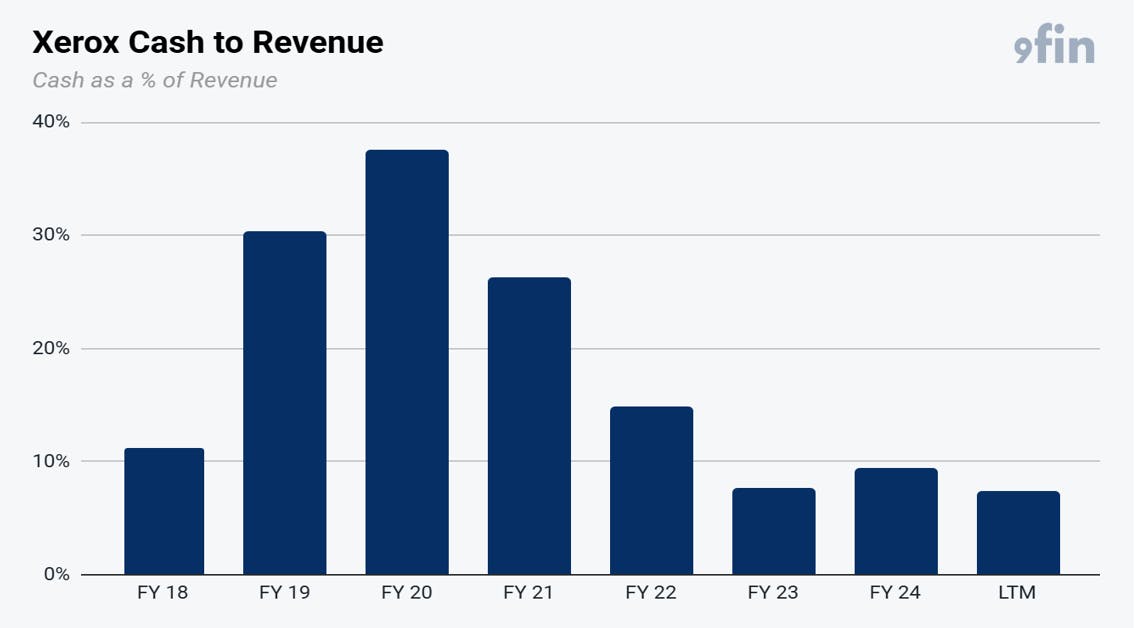
The company’s cash as a percentage of revenue has been at its lowest level since FY 18 at 7.2%, with 9fin expecting Xerox to be hovering around its range of minimum liquidity needed to run the multinational business. As the integration of Lexmark progresses, 9fin expects the minimum liquidity threshold to increase as well.
S&P downgraded the print and office supply manufacturer to CCC+ on 5 November, stating an uncertain print demand environment raises questions over the company’s free cash flow, especially following the federal government shutdown and continued tariff uncertainty.
Xerox revised its guidance downward for the second time this year during its third quarter earnings call, with free cash flow now expected around $150m for FY 25. For more information regarding the company’s third quarter results and earnings call, read up on 9fin’s earnings review here.