
Market Financial Solutions is one of the biggest shocks to ever hit the UK mortgage market, and it’s a complex situation. 9fin has been at the forefront of coverage, but it can still be tricky to follow — so here’s a cheat sheet with everything we know so far.
What happened?
MFS was a large bridging lender focused on high-net worth clients, which raised more than £2.5bn of funding from multiple banks, asset-backed investors, and high-net-worth investors.
This brought it into contact with various politically exposed persons, including most notably former Bangladeshi land minister Saifuzzaman Chowdhury, accused by the current Bangladeshi government of embezzlement. Last year the wheels started to come off when Barclays froze its bank accounts.
This pushed the firm into insolvency, and on detailed inspection of its funding facilities, insolvency professionals found a giant hole where some of the collateral ought to have been, with more than £1.3bn unaccounted for, and evidence that some of the mortgages had been “double-pledged” — used to draw down funds from multiple sources simultaneously.
Founder Paresh Raja had left the country early on in the process and was seen in Dubai. Insolvency professionals obtained a worldwide freezing order over his assets, and have now commenced multiple processes to try to obtain recoveries.
The failure of the firm, the large losses, and the double-pledging have been a massive shock to the securitisation industry in Europe, whose largest single business line is financing UK mortgages. Firms involved have sharply adjusted their risk appetites, while issuers and investors alike have redrawn due diligence and verification processes to try to insulate themselves from the scandal of MFS.
With such large losses in prospect, funders are likely to find themselves competing through the courts for the shrunken pool of collateral. The case has already proved one of the largest corporate collapses in the London market, producing mandates for almost every major restructuring advisor and law firm.
Initial investigations by insolvency teams have turned up multiple examples of questionable behaviour, but all cases have been conducted on a civil basis so far — the multiple allegations of fraud have not been fully tested in court.
Timeline of key events
January 2024 — Loan “deficiencies” passed between funding silos
18-02-2024 — Bloomberg investigation on Chowdhury mentions MFS lending
20-02-2024 — Deutsche Bank/Castlelake vehicle (Pearl Bridging) repaid
18-09-2024 — Al Jazeera releases documentary, ‘The Minister’s Millions’, highlighting Chowdhury’s connection to MFS
10-03-2025 — CPPIB vehicle (Garnet Bridging) repaid
23-07-2025 — Morgan Stanley/Avenue Capital vehicle (EarthAve Bridging) repaid
27-10-2025 — SMBC funding vehicle buys MFS assets
27-10-2025 — Wells Fargo signs new MFS financing
05-11-2025 — Jefferies signs new MFS financing
17-11-2025 — Barclays account banking arm freezes MFS operating accounts
28-11-2025 — Barclays investment bank issues acceleration notice on Mercury Funding
03-12-2025 — Barclays IB starts talks with Teneo about receivership
23-12-2025 — Some private MFS creditors are repaid
31-12-2025 — Other private MFS creditors are given security interests in MFS vehicles
22-01-2026 — Barclays investment bank puts BTL facility into receivership
11-02-2026 — MFS files lawsuit to force Barclays to unfreeze accounts
19-02-2026 — MFS attempts to put itself into administration
25-02-2026 — Paresh Raja directs “clean-up” of MFS documents
25-02-2026 — Court approves OpCo administration after application by creditors
March-June 2026 — Almost all other MFS-linked vehicles put into administration
18-03-2026 — Worldwide freezing order served on Paresh Raja
20-03-2026 — FCA opens enforcement investigation
04-06-2026 — Funding vehicles start to form creditors committees for MFSL and MFSIL
05-06-2026 — Macquarie vehicle (Solar Bridging) is the last funding silo to enter administration
April-present — Funding vehicles and OpCo ask for court orders to unfreeze funds
28-09-2026 — Paresh Raja files defence, blames Barclays
What was the structure of MFS?
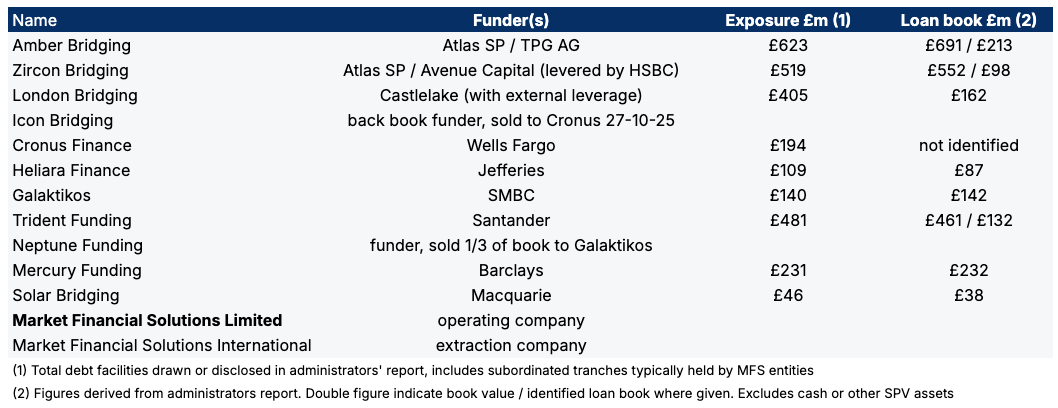
Let’s start with the funding silos — here’s a quick summary
Source: 9fin reporting and administration filings
The details provided by the administrators of these various funding silos have opened a window on the MFS business, and its route into collapse.
That allowed us to look into how much leverage lenders gave MFS — and at some of the senior spreads lenders were getting. There was more leverage on buy-to-let lending than bridging, and more leverage on more granular (smaller loans) bridging books.
But one takeaway was that MFS was borrowing on off-market terms — accepting lower advance rates and paying higher spreads than others might — making the firm the perfect client, until it wasn’t.
The overall business structure seems to have been considerably more complicated. Many of the subordinated positions in the warehouses were held by PSR Equities, a vehicle named for founder Paresh Raja (whose middle name is Shantilal).
Several other defunct funding vehicles existed. Some funding vehicles (Macquarie’s Solar Bridging, for instance) were reused for different facilities, and Raja also had stakes in other businesses — Interbridge Mortgages, for example.
Private creditors, some linked directly to Raja (his stepson, for example) also funded MFS entities, sometimes through the same vehicles as institutional lenders, sometimes through reused funding vehicles.
An entity called Twinwin seems to have played a prominent role, borrowing money from several of the funding vehicles, sometimes against the properties that had also been mortgaged by other borrowers.
Hundreds of different property-owning companies also existed, tied together through common ownership or directorship, while several MFS entities have been named by some insolvency professionals as “extraction companies” — that is, used to take money out of the group of companies for Raja’s personal benefit.
Insolvency appointments
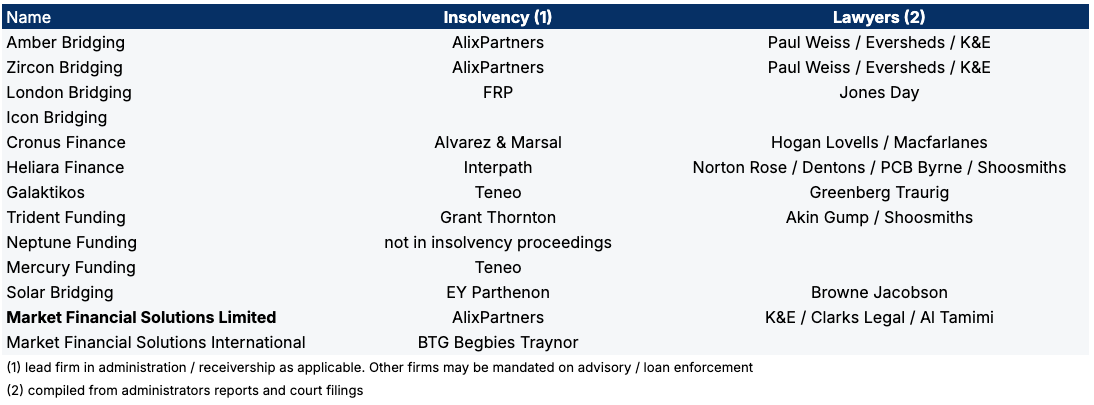
Nearly all of these vehicles, and a host of other associated MFS-linked vehicles, are in some kind of insolvency process. Given the number of funding vehicles and entities, a fair proportion of London’s insolvency firms and restructuring lawyers are currently mandated on MFS-linked business — and these appointments have sometimes been controversial.
Source: 9fin reporting and administration filings
MFS founder Paresh Raja initially tried to appoint his own preferred administrators, which started the chaos. He was unsuccessful, and the operating company was placed into administration at the behest of Amber and Zircon, the two Atlas-funded SPVs, with the support of Castlelake.
This was followed by a wave of further administration applications, including those of multiple property-owning companies, but there were hiccups along the way. Pearl Bridging could not be put in administration because of a corporate governance overhang from its previous life as an institutional funding vehicle. Two of the AlixPartners administrators had to resign from their roles on funding vehicles.
Most recently, creditors insisted that Nimish Patel of Coots & Boots resign as an administrator of extraction company MFS International, citing a perception of conflict of interest — he’d known Raja for 20 years.
How it happened
Corporate investigators, journalists including 9fin, and many interested parties have their theories about why and how all this has been able to occur, and who was responsible.
One of the most comprehensive rundowns so far came in May, in a claim against Raja from OpCo administrators AlixPartners.
This outlines the role of deputy head of financial analysis Faraz Khan in moving money from the SPVs into MFS International and thence into Raja’s personal accounts, as well as collecting boxes of cash, as well as the transfer of money to nominee companies to fund property purchases, and to luxury retailers to pay for Ferraris and other items.
It also explains that the financial analysis and treasury teams were kept separate, ensuring neither had access to the other’s records (which would have allowed them to see any double-pledging), and highlighted a mechanism for dealing with loan “deficiencies”, essentially selling delinquent loans at par into other SPVs. It claims there is evidence of Raja instructing the deletion of documents.
Raja “strongly denies” the allegations and plans to present his full account of what happened through the court process, a spokesperson told 9fin.
“He has consistently maintained there was no fraud or dishonesty,” the spokesperson said. “Assets which the administrators characterise as missing were held through nominee structures for the benefit of MFS and its creditors, a position set out in detail to the administrators in March 2026”.
Raja set out his objections in a comprehensive defence document in September, which points again to the property portfolio, and challenges the figure of £1.3bn in missing funds. It does not, however, lay out why the funding silos were lending against property said to be beneficially held by MFS.
An application to place Twinwin in administration brought to light further details on some of the mechanics involved, including properties with multiple charges against them, and the disavowal by solicitors from Sriharans and Gunnercooke of documents they supposedly certified, which they said they had never seen.
9fin reported that although previous lenders had commissioned collateral reviews, including from Rockstead, the facilities had successfully passed this examination — which has led to an increasing industry focus on getting to the “golden source” for collateral diligence, rather than simply checking one spreadsheet against another emanating from the same lender.
We also looked at some of the Land Registry documents for MFS-linked properties, noting multiple charges registered for separate funding vehicles — which should be impossible for a first-ranking mortgage security — as an example underscoring that lenders were not regularly checking this publicly available source of information.
Most securitisation facilities are structured using the transfer of beneficial title, rather than legal title — which is, in theory, a structure that makes it much easier to double-pledge assets. MFS used the more robust legal title transfer, but still successfully slipped through due diligence checks.
We’ve been less focused on what subsequently happened to the money — but Raja is known to have an extensive supercar collection, some of which has been sold, and a fondness for expensive watches and sports memorabilia, and to have frequented some of Mayfair’s most expensive establishments (including a membership at exclusive members’ club 5 Hertford Street).
The players
Whatever happened, deficient controls played a big part.
9fin reported early that some of the MFS audit and accountancy firms seemed less than distinguished — can you audit a £2.5bn lender from a box room above a shop in Morden? — but there’s a trail of further complexities.
One MFS auditor was the director of a firm which also borrowed from MFS, while administrators argued in court that Magus Accounting had incorporated hundreds of property SPVs for Raja, which MFS silos subsequently lent money to.
Dipendra Amin, an accountant with Magus, also owned a stake in a firm promoting document completeness and integrity for the mortgage market, and was formerly a business partner of Rupin Banker, currently fighting a web of court cases over the collapse of Indian edtech company Byju’s.
The audit regulator, to the surprise of nobody, has become involved. The Financial Reporting Council is looking at Magus Chartered Accountants, as well as Berkeley Finch, whose founder Ajay Yadav also borrowed from MFS, and Silver Levene, which audited funding vehicles.
The fights
With nine major funding vehicles, and a shortfall of perhaps £1.3bn in mortgage collateral, it seems likely that large creditors to the firm will end up engaged in legal proceedings against each other.
Administrators for Macquarie’s funding vehicle, Solar, warned of this possibility in August.
There are, however, some signs of cooperation — vehicles funded by Atlas, Castlelake, Santander and Wells are cooperating in a creditors committee for Market Financial Solutions Limited, the OpCo, while Atlas, Castlelake and Santander have formed a creditors committee for MFS International.
The main crop of lawsuits so far has focused on getting money out of the account banks, usually Barclays or Lloyds. The most controversial is likely to be the claim from the operating company against Barclays, filed in August, since Barclays intends to fight this on the basis of an indemnity clause in its own funding facilities.
Others, for example Trident and Heliara, have been successful in unfreezing the relevant accounts and gaining access to funds, which can be used in part to pay for the administration and investigations.
The fallout
The collapse of MFS has sent shockwaves through the securitisation market in Europe.
Some senior professionals have taken the rap for their firms’ investments and losses, for example at TPG Angelo Gordon and Atlas SP Partners. Firms which turned MFS down, or got out early, took victory laps in public or, more commonly, in private.
Affected firms have stepped up due diligence across their securitisation books — Wells Fargo, for example — while Barclays CEO CS Venkatakrishnan said publicly that his bank would be “constraining lending to certain structured finance counterparties.”
UK borrowers in particular have enhanced their collateral reporting, even if they lend in different sectors.
We reported on measures taken by used car financier Oodle Financial Serviceshere, and on the surprisingly rapid response of the Australian securitisation market here, as well as running a webinar on collateral verification.
Top-tier lenders, though, have readily ridden out the storm and deals have continued to get done.
While the bridging market is expected to get a shakeup from MFS, it doesn’t mean investors are out, and arguably the disruption presents a buying opportunity. Though negotiations were underway before the MFS news broke, US hedge fund Balbec Capital, to take one example, pushed ahead with its purchase of Funding 365 in June.
The changes are likely to be lasting, and will shape market practice for years to come.