This guide is part of our webinar series on building AI workflows. To explore all our sessions, click here.
I’m a senior credit analyst at 9fin. When a new issue launches and I have until lunch to build a view, I work with my AI assistant to get the numbers in a fraction of the time.
You may already be using AI tools to summarise large documents, but 9fin’s Connector can help in a way that isn’t possible using a standalone AI assistant; through the MCP, I have easy access to bond and loan covenant data, OMs, editorial content, and much more.
In the example below, the deal launched at 8.45am, and thanks to my setup with 9fin’s Connector, I had a first output ready by 9.30am — a credit memo, relative value analysis, EBITDA analysis, and answers to anticipated questions from the investment committee.
I treated the output as a first draft, and every figure linked back to its source, so I could click through to the original document and check the ones that mattered before anything went ahead.
Here’s a snippet of what I ended up with.
But let’s rewind: why use AI at all?
A refined credit view helps your PM understand whether a credit is worth owning at the price and on the terms stated. And timing is important, with books often closing within a few days for bonds and within a week or two for loans, while building the view itself takes up a lot of time.
You have to dig through OMs for financials and cap structure; find comparable recent deals; challenge the EBITDA adjustments; and then write up your findings.
It’s repetitive, and usually one task of many in your day. So by using your AI assistant, combined with 9fin’s Connector, you can complete your tasks to the same high standards in one familiar chat interface in minutes.
Let’s get into the process itself — I’ll be using fashion retail chain Takko as my example throughout.
We covered this exact walkthrough in our AI workflows series.
Objective 1: to build a credit summary
The prompt: Takko Fashion is in the market with new senior secured notes. Using the 9fin MCP connector, find the preliminary offering memorandum and write me a credit QuickTake from it:
- Deal overview: the new notes, use of proceeds, ownership and history
- Capitalisation: pro forma cap table (as a table) with leverage and liquidity
- Business overview: what it does, store footprint, LTM revenue and EBITDA, revenue mix, cost base, cash flow, NWC and capex
- Industry overview: market size and growth, key trends, competitors
- Risk factors: the six or seven most material credit risks, each with supporting numbers
The output: I get a breakdown of Takko Fashion’s senior secured notes, with figures linked to the source document. The output covers everything from the pro forma cap structure to leverage to key covenant baskets, as well as the structural points worth flagging.
One interesting point to note: the output first identifies where this particular credit is in its ownership cycle. It highlights the 2023 restructuring, where we saw the original owner lose control of the business via a debt-to-equity swap.
This forms the bedrock of our understanding of the history and context behind not only the credit but also the deal itself.
Objective 2: to benchmark against the market
The prompt: Using the above information, build me out a detailed RV analysis considering the current price talk for the new notes against Takko’s closest comps in the European high yield market. For its two closest peers, build me out a detailed head-to-head analysis.
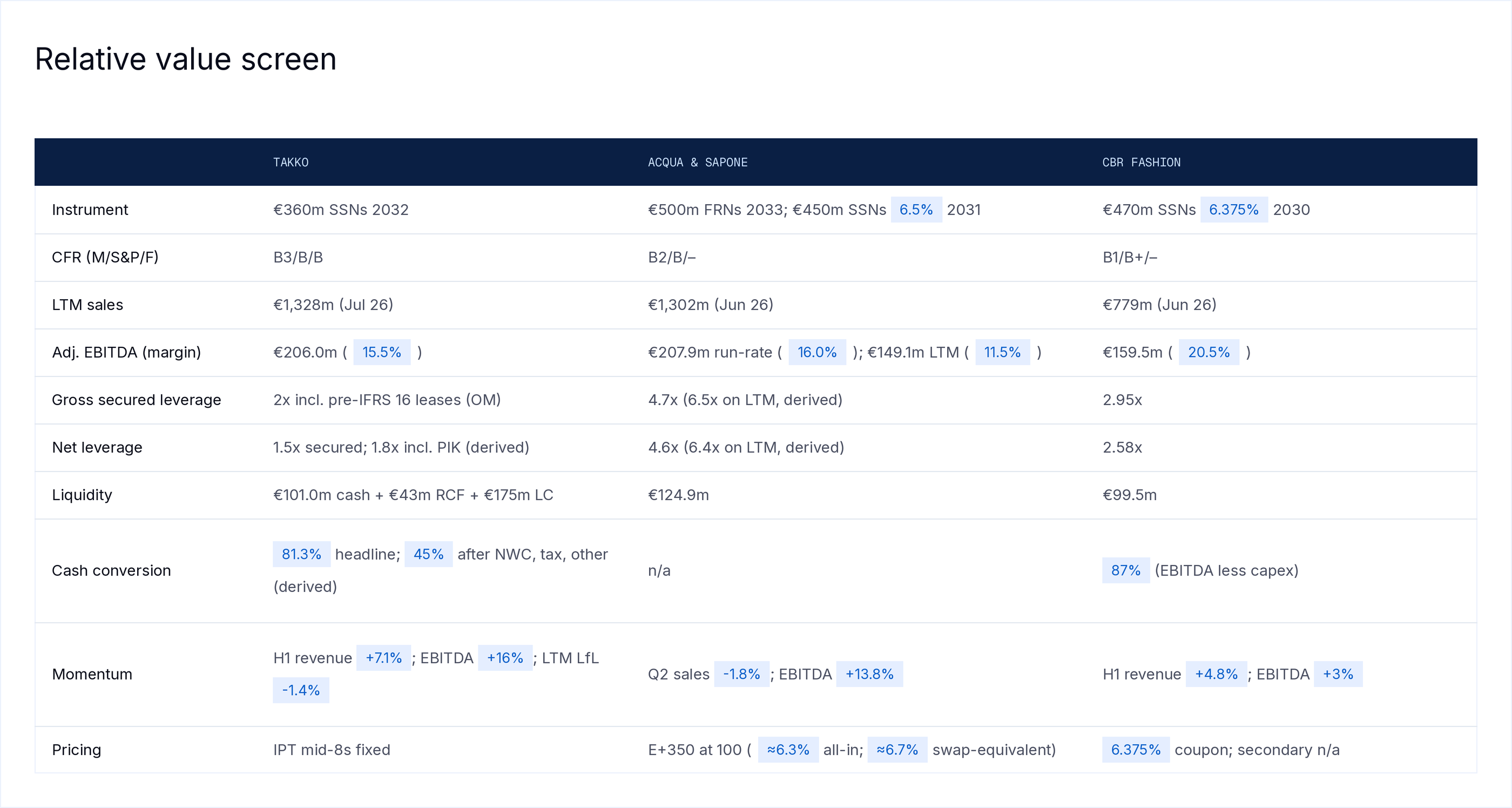
The output: My AI assistant builds out a relative value screen and also pulls from 9fin’s bonds database to find the closest comps, with a detailed peer breakdown, covering everything from leverage to pricing. I also get a clear view on whether the deal is priced attractively and which tranche offers the better value.
Note that I can use one simple prompt to screen for the closest comparable new issues by sector, rating, size, and sponsor. And this is where 9fin’s MCP access to our structured databases makes a huge difference.
Taking a closer look
There’s a section in the output where my AI tool has made a connection between European retailers with overlap in the German market and in value retailing. The result goes beyond just numbers pulled from a database and focuses on business models and how they relate to each other.
The table below places the three closest comps side by side and compares them across various points, from revenue and EBITDA profiles to recent pricing.
You can customise this to cover the exact data points you need.
Objective 3: to challenge the EBITDA adjustments
The prompt: Build me a detailed bridge from Takko’s reported LTM EBITDA to the marketed EBITDA used for pro forma net leverage in the preliminary OM. List every adjustment, size each as a % of EBITDA, and tell me which a lender should haircut and why. Then compare that with the consolidated EBITDA definition in the Description of the Notes. How much further can EBITDA be adjusted, and what could that do to covenant leverage?
The output: My assistant pulls the reported-to-marketed EBITDA bridge straight from the OM, with every adjustment sized and cited. I also get adjustments grouped by type, like standalone, cost savings, and run-rate.
Taking a closer look
Let’s assess the bridge itself in the video. You can see my AI tool has highlighted that about 45% of the marketed number is built up from adjustments.
It’s also given a view on each of these adjustments to arrive at a lender case for EBITDA based on how much you actually want to add back into the number.
Not only that, but the output then cross-references this number to the index to see what a covenant definition of EBITDA could be. That’s really important when you start thinking about calculating your baskets and assessing the flexibility afforded by the covenants.
Finding the reconciliation table, reading all the footnotes, and cross-referencing, can take up over an hour. Now, I can get an output I’m confident with, in minutes.
Objective 4: to create a list of pushback points
The prompt: What are the five most important questions I should be prepared to answer heading into my investment committee later?
The output: I get my agentic credit memo, written out as evidence for five questions the investment committee is likely to ask, with the likely objection behind each point and the sourced answer to it.
Taking a closer look
This prompt can help LevFin analysts:
- Know where they rank — Map super senior claims, collateral gaps and covenant capacity before committing
- Stress the credit story — Test the durability of operating momentum across scenarios such as price cuts or margin declines
Build once, reuse for every deal
I turned this entire workflow into a skill that I could use across deals. My prompt was:
Build this workflow using the 9fin MCP connector into a Claude skill I can use for all my future primary issuance analysis. Call it '9fin credit memo'.
I now have a fully established workflow that helps me pull a credit view together in minutes, with each deal that comes to market. It’s also:
- Consistent across the team. I can share this skill with every analyst, so they can produce the same output to the same standard every time
- Fully customisable. I asked my AI assistant to structure the output in 9fin’s house style, but you can easily give the AI your internal memo templates or IC formats to pull from
- Easy to refine. I can improve the skill after each new deal, learning from the cumulative changes
I go through this whole workflow in the second webinar in our AI workflows series — get the replay here.
And head over here for more on 9fin’s Connector.