The recent spike in Japanese government bond yields is raising eyebrows in the CLO market, where Japanese banks are big buyers of triple-A paper. This concern comes as analysts forecast an 80bps hit to the country’s GDP as a result of a potential tax cut following upcoming snap elections.
Prime minister Sanae Takaichi floated the idea of the tax cut on Monday along with promises of increased government spending, as she announced a snap election for 8 February. Following that announcement, yields on 40-year JGBs jumped to their highest on record while 30-year yields jumped the most since last year’s ‘Liberation Day’ tariff announcement:
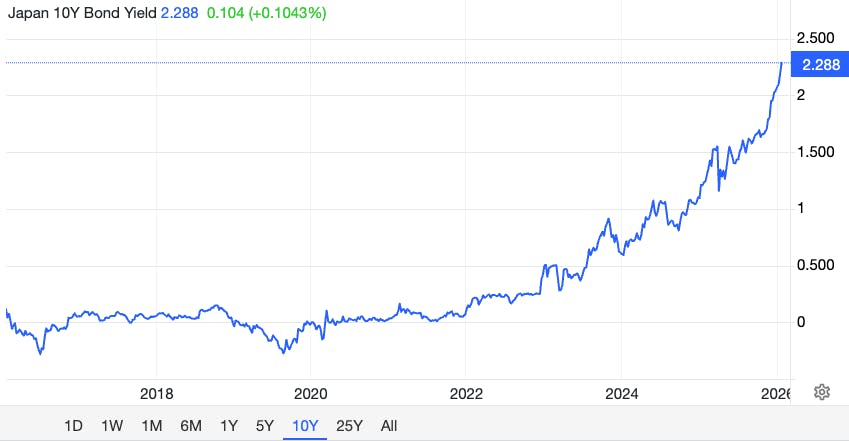
Whether this dramatic shift (which some have referred to as a potential ‘Liz Truss moment’ for Takaichi) will impact the smooth functioning of the CLO market is unclear. There has been little impact on demand for triple-A CLO paper so far, according to syndicate bankers.
Still, market participants are watching nervously for any signs of change. While Japanese banks are not quite the force they used to be in CLOs, they have been lynchpin buyers for decades and are still an important part of the ecosystem.
“For CLOs, the sharp rise in JGB yields has led to relatively unattractive hedged US CLO AAA yields,” said analysts at JP Morgan, although they noted that investor reaction to this will vary.
“More broadly, if concerns about Japan’s fiscal expansion and behind-the-curve BoJ policy lead to an expansion of risk premia, the already wide gap between the US-Japan interest rate differential and USD/JPY will not necessarily prevent further yen depreciation,” the JPM analysts added.
Any reduction in demand for the highest-rated part of the CLO cap stack could risk slowing the market down just as it comes into 2026 with renewed demand and a growing pipeline. As recently reported by our CLO team in London and New York, issuance is revving back up and is expected to support a growing pipeline of LBOs, particularly in the US.
This nervousness in the market reflects the high drama of the situation in Japan, with analysts noting the precarious timing of the snap election.
Takaichi is taking a “huge political gamble” in calling an election during a time of year typically reserved for budget planning, said Masayuki Nakajima, a senior strategist at Mizuho, during a briefing on Tuesday. While Takaichi’s LDP party will likely see victory in the February elections, there is a 20%-30% chance of either a setback or defeat, according to Mizuho.
GDP impact
So far, Takaichi’s promise to suspend Japan’s consumption tax on food is just that — a pledge. It hasn’t even made it into her campaign’s official manifesto yet. But a quick read of the room suggests there’s little reason for Takaichi not to make it official.
Opposition parties across the board have called for at least some kind of reduction to the tax, which suggests public appetite for a cut is already there. In the February election, Takaichi’s real ideological opposition may come from fiscal hawks inside her own party, rather than from the opposition.
Should the cut go ahead, Mizuho sees as much as 80bps of GDP being erased as shoppers will need to pay less for groceries. CPI would tumble too. That would put the BoJ in a tough position as it’s long been on a mission to sustain higher inflation by raising rates.
The central bank could come to Takaichi’s aid to help stabilize the situation, and has some levers to pull. For example, it could slow the pace at which it reduces its own purchases of JGBs.
Already, the central bank has said it would address higher yields by cutting its monthly bond purchases by just ¥200bn each quarter, starting in April. That would be a slowdown from the current pace of ¥400bn a quarter.
Japanese officials have already come out to try and quell the market impact. At Davos on Tuesday — where the dispute over Greenland is already ramping up tensions — Japan’s finance minister Satsuki Katayama called for cooler heads.
“Since last October, our fiscal policy has consistently been responsible and sustainable, not expansionary,” said Katayama on Bloomberg TV. “I’d like everyone in the market to calm down.”