An interesting week of higher-than-expected data prints, last minute repayments and late initiatives. To COP it off was another potential scandal in the German Real Estate sector which makes us wonder if we should be looking at the sector in Aggregate (pun intended) or look for Core(al e)state opportunities?
The Merriam-Webster dictionary’s definition of transitory – is that it only lasts for a short time.
I doubt that beleaguered Central Bankers share this interpretation, or they may wish to use their friends in high places to hack and change the respective wiki or Investopedia entries.
Ben Hunt from Epsilon Theory puts it expertly: “For the better part of a year, the Federal Reserve and US Treasury have made a concerted and highly intentional effort to shake their collective finger at us and tell us how to think about inflation. That effort includes redefining the measurement of inflation so that we think about it in the approved double plus good fashion. I'm not telling you to fight the Fed. On the contrary! But I am telling you that we don't have to play this pretend game of "debating" the transitory nature of inflation.”
Wednesday’s US headline CPI print of 6.2% was the worst since 1990 – when yours truly was a rookie Aussie Eurobond trader and US fed funds had an 8-handle, (btw Australian rates were at 15%, my UK mortgage rate on my first house went from 5% to 8% in six-months!)
As my former colleague Jim Reid from Deutsche observes: “with nominal yields outpacing real yields, inflation compensation increased across the curve, with five-year breakevens increasing 11.1bps to 3.10%, an all-time high, with 10yr b/evens at 2.71%, the highest since 2006.”
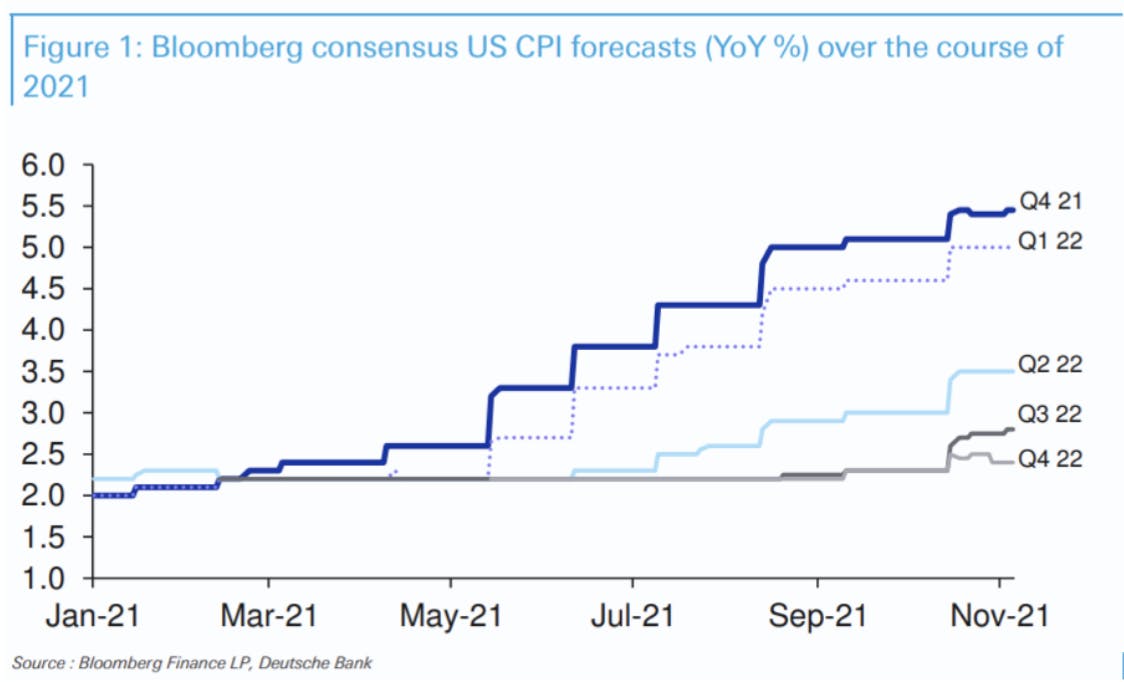
It is becoming harder to say that this is down to surging energy prices and one-off reopening effects. The rises were broad based, with core CPI for the month up 0.6%, 4.6% annually. Housing inflation is now the highest since 1991, with Deutsche analysts openly talking about parallels with the 1970s and threats of stagflation as inflation threatens to get out of control and policy errors mean that this all ends messily.
It wasn’t surprising that the 30-year US Treasury auction later that day was sloppy, having the worst tail since 2011. President Biden said reversing the trend of rising inflation was his top priority, putting the energy sector firmly in his sights, but weirdly he failed to put any pressure on the Fed whose job is to tackle inflation, sitting pat on rates. At this point they are so far behind the cycle (rate hikes take 18-months to fully take effect) – they are in danger of being caught up and lapped by the cycle coming after this one in their team pursuit.
Investors are praying that inflation is going to be only for the short-term, otherwise their meagre returns will be decimated. Their starting point ahead of the tapering of QE is incredibly poor, with real yields at historic (negative) lows, meaning that economic policy is way looser than before the GFC.
Once again risk assets are relatively unscathed. Gold rose (finally) but Bitcoin has long since replaced it as the inflation safe haven, hitting new highs – perhaps anticipating that Elon will put his Tesla stock sale proceeds in the metaverse as he awaits his tax bill from Elizabeth. The crossover stubbornly remains below 250bps, however, suggesting that European High Yield remains relatively immune to global economic shocks, or at least for now.
For those wanting to delve back into economic history for clues and trying to remember lessons from their economics professors, from bitter experience this grey-haired veteran knows inflation can easily spiral out of control. The Ghost of Arthur Burns in the 1970s.
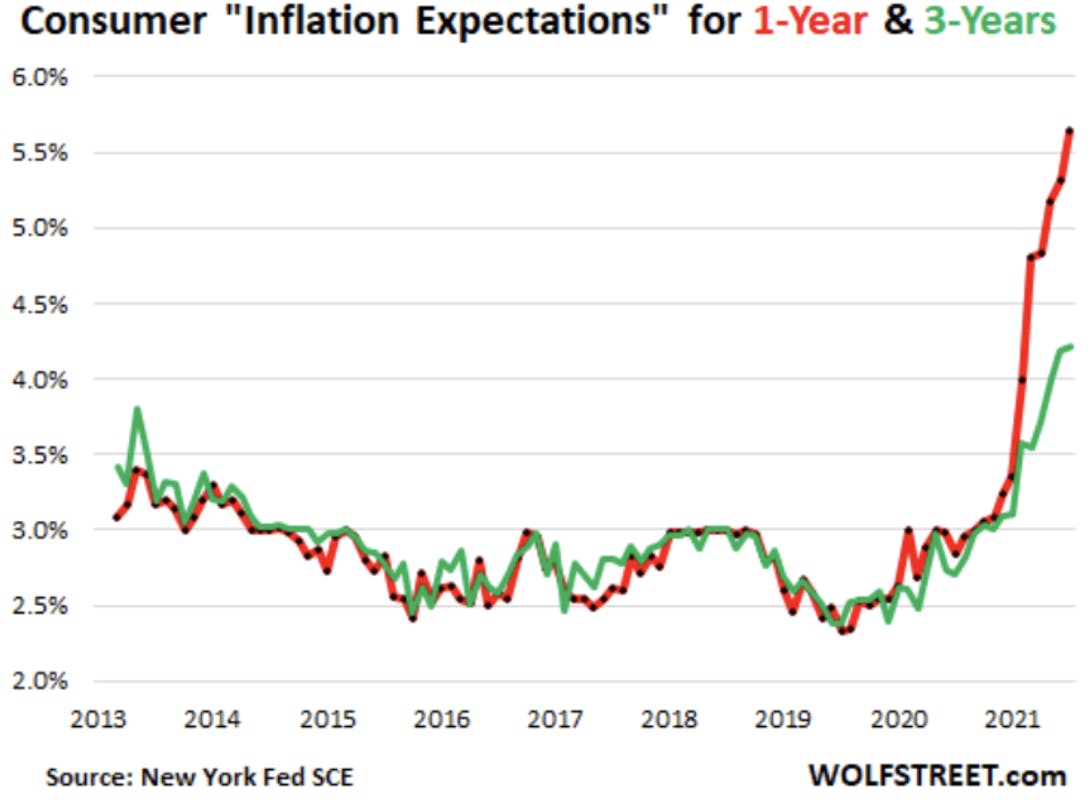
As consumers and workers' expectations rise, it can become a self-fulfilling prophecy. The Fed has openly talked about wanting longer-term inflation expectations to remain ‘well anchored’ at 2%, so the New York Fed data in the chart below should be worrisome. I agree with Wolf Richter, the Fed has lost control of the inflation narrative.
If consumer prices were not bad enough, input costs are skyrocketing – the highest for 11-years - and supply chain difficulties (shipping rates have eased slightly of late) are set to continue well into 2022. But for now, company earnings remain relatively unaffected as most believe that they have the ability amid strong demand to fully pass on increased costs to their customers and consumers, preserving margins.
As this excellent Economist leader outlines, it is all about pricing power, Warren Buffett says is his “single most important decision in evaluating a business.” The Economist quotes Bank of America research with mentions of “price” or “pricing” in American earnings calls—a proxy measure for pricing power—increased by 79% in the third quarter from a year earlier. In the second quarter, such mentions were up by 52% year on year.
In theory, pricing power is easier for firms with market dominance to ‘mark-up prices’ to maintain the gap between selling prices and marginal cost; those with a higher market share, with the volatility and skew of profit margins also significant contributing factors, says the Economist.
As the European High Yield earnings season gets underway, search results on our site for price increases and supply chain issues have thrown up a lot of names.
One example is South-African paper manufacturer Sappi, struggling to ship its involuntary Q4 backlog of 100,000 tons of dissolving pulp (DP), amid supply chain issues. Despite a 23% drop in DP volumes, an increase of 59% in price per ton saw segment EBITDA return to pre-Covid levels. From 25 October it has raised paper prices across all grades and has implemented an energy cost surcharge to recoup a $17m (per quarter) impact of higher energy prices. Sappi operates in a sector which is traditionally extremely competitive and cyclical, we will be watching closely to see if it can make the rises stick.
Not all companies are in the happy position of being able to fully pass on increased costs and/or there is often a lag of a quarter or two before they can recoup lost revenues. Earlier this year, Kloeckner Pentaplast disappointed investors on its inability to pass on rises of raw material costs, which in hindsight appear tame to what has happened recently. Looking again at their conference call write-up from early September, bondholders may be right in not giving management the benefit of the doubt, and we wouldn’t be surprised if their full year guidance is revised down further, when the next set of earnings arrive. Remarkably their bonds are hanging in there above 90, while other difficult single-Bs which struggled post launch such as Standard Profil are becoming more acceptable in the 80s.
Boparan is famous for its limited pricing power. There was another blow for the Chicken King this week, with the competition and markets authority issuing an initial enforcement order, saying it had reasonable grounds to suspect that enterprises carried out by Banham Poultry (acquired by Boparan Private Office) and Boparan Holdco have ceased to be distinct. Boparan hoped the poultry processor acquisition could enable it to maintain capacity and fulfil customer orders in the run up to Christmas. But now they are stuffed – the two businesses should operate independently, says the CMA. No chicken in a (single) basket.
Aggregate Sum; Addled by Adler; Core Concerns
The German Real Estate sector continues to be a key focus at 9fin, as we help those addled (definition: thrown into confusion, unable to think clearly) by Viceroy’s short-seller report on Adler.
Our own Emmet McNally resurfaced from his deep dive down the Adler rabbit hole this week, with an excellent analysis on Adler Real Estate LTV calculations where we arrive at a 9fin adjusted figure.
We do this by adjusting several balance sheet items to arrive at what we see as a more realistic, if not a little conservative, 9fin definition of LTV. We do this for the purpose of exploring credit risk at the company rather than to determine capacity, or lack thereof, under financial covenants governing borrowing activities that are based on LTV ratios.
As Emmet says in his report (non-subscribers sign up here for a copy) “In light of a large portion (~57% of units) of Adler RE’s yielding portfolio subject to two disposal transactions which appear to value assets at a premium to book value, some might take the view that portfolio valuations at Adler RE are justified or at least in line with the current market. That said, there is still much to scrutinise in broader portfolio valuations at Adler Group, including at Adler RE, as certain assumptions and expectations appear ambitious when compared with peers and in broader market contexts.”
I won’t give away our findings in a public forum, but subscriber feedback is welcomed as it helps inform and refine our future reports. Next up is a report for Adler’s largest shareholder, Aggregate Holdings.
But for those looking to get up to speed and unable to wait, yesterday we released our Aggregate Stressed QuickTake. If you are not a client, please sign up here for a copy. Earlier this week, there was some good news for the cash strapped real estate developer, with one holder on FinTwit confirming that he had received his bond coupon. But as another Fintwit commented in response this left just €40m at the HoldCo as over €300m was trapped at Opco. We are unable to verify this claim at time of publication, but it would explain reports that distressed funds such as Oaktree, Fortress and Apollo are in negotiations over providing emergency liquidity lines.
As we outline, most of Aggregate’s EBITDA comes from revaluations of its development portfolio with little in rents or in investment dividends to service its debt. An upcoming put for its Portuguese VIC Properties convertible next May is one major liquidity event. Given significant revenues are unlikely to arrive until at least 2023, when its developments come onstream, it may explain the company’s desperation to borrow margin loans against its Adler stake and agree to an 18-month call option on the Adler shares with a competitor at a significant discount to Adler’s Net Asset Value.
Bears on the German HY complex cite the disconnect between the rates being paid on the HY bonds and the high cost of development finance available from specialist lenders. A great deal for the borrowers, but it doesn’t reflect the risk/reward profile, they argue.
Corestate for years has provided mezzanine finance to local developers in the mid-teens. Incredibly, it says that it has never had a single default, and says that institutional investors which it relies to invest in vehicles which in turn provide funds for its mezzanine business, remain confident in the prospects for the German RE market.
In recent weeks the yield on Corestate’s high yield bond rose from 5% pre-Viceroy into the mid-teens. It says it remains confident that it can deleverage to around 3x by the end of the year, to facilitate a likely refinancing next spring. However, to achieve this requires over €230m of net debt reduction in the fourth quarter with Corestate disappointing some analysts by its inability to deleverage by €50m in the third quarter as previously guided. Analysts on the third quarter conference call quizzed management on their exposure to Adler, and whether it would use any of its unrestricted cash to repurchase its bonds.
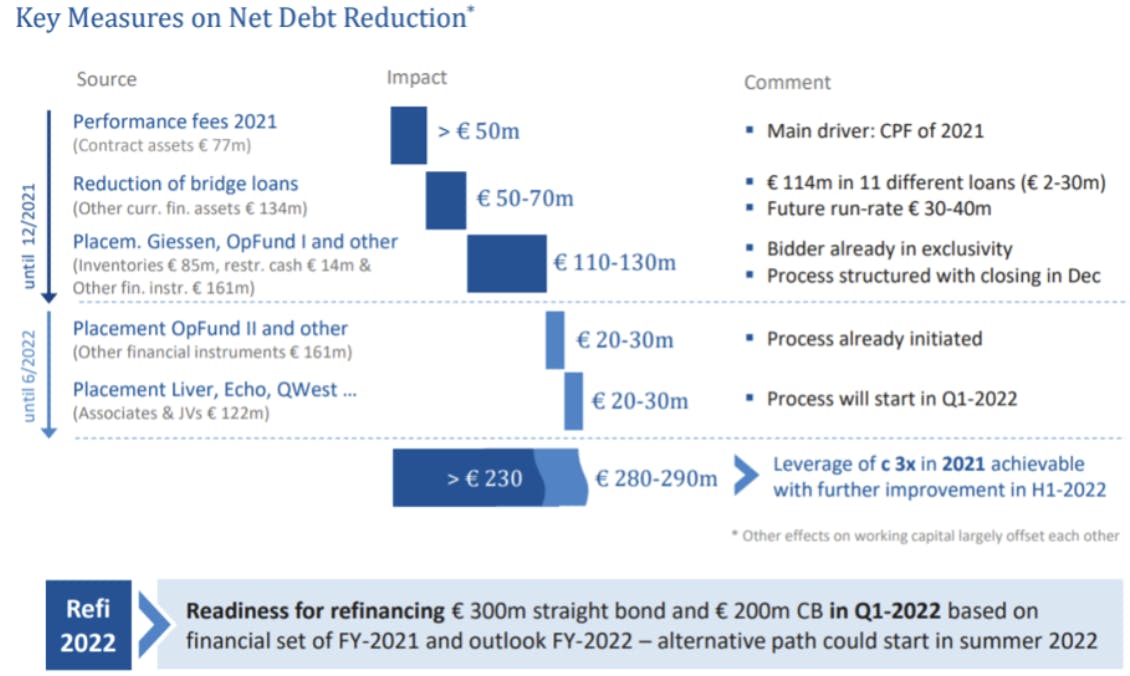
Corestate has €196m outstanding on its 1.375% convertibles due November 2022. It is limited from issuing further debt, by a 3.5x debt incurrence covenant, with its €300m of 3.5% SUNs due April 2023 in the mid-80s. If it can get to 3x leverage and refinance, these are a steal at current levels.
But Aggregate’s owner is a significant shareholder, and Corestate has financed most of theirs and Adler’s developments. But despite this, management said that they have no problem credits, declining to detail their exposure to Adler. It’s business model and reported returns are impressive – over 80% of its business relates to Core and Core plus properties – a 7.7% return on equity, seemingly too good to be true. I won’t repeat the famous saying.
Another casualty of the recent reappraisal of German RE values is Signa Development, which as we pointed out at launch in July had major governance concerns, mostly notably corruption investigations and money laundering allegations around its founder Rene Benko. This week the FT revealed that he and two other Austrian billionaires were charged with bribing Green Party politicians. The Austrian State Prosecutor has filed a criminal indictment on Wednesday, saying that they sought to influence planning decisions on at least 15 major property developments in Vienna. Impressively, the bonds which have dropped from 97 to 87 since launch, rallied a point or so, after the news.
Italy calls in the experts, UK landlords pushed into arbitration
A new Italian out-of-court negotiated settlement procedure comes into effect on Monday.
As our Italian Insolvency Law update outlines, the newbie process is likely to supersede Article 67 under the new code. That was also light touch but had a narrower scope and was often used by creditors to prolong negotiations and kick the can down the road, noted a local lawyer. Hopes are high that the newbie can be more effective, with an independent expert charged to facilitate negotiations between the debtor and creditors – who unlike the old process have more duties and are placed under greater scrutiny on their behaviour. The timeline is impressively short at 180-days for an agreement, refreshing for those familiar with Italian restructuring deals taking years to complete, with heavy court involvement and a high propensity for litigation – as Fitch recently bemoaned. Creditors for Moby, Astaldi and Maccaferri would likely concur.
There are also improvements in other Italian insolvency processes, effective in May 2022, as Italy seeks to move into line with the minimum standards being set under the EU insolvency directive.
But lawmakers who may be trying to be too clever have irked many in the Italian restructuring community, with the introduction of a new Safeguard procedure – which thankfully is not the same as its French namesake – but could end up being as controversial.
It imposes obligations on companies and their auditors at an early stage of corporate crisis, which some observers believe are unworkable and will create conflicts of interest, especially for auditors. The auditors must notify an organisation for crisis management (OCRI) if they find evidence of a crisis, the OCRI then takes control of the process, and also notifies state institutions such as tax authorities.
Safeguard was signed into law in September, but subsequently postponed to December 2023, with many restructuring professionals hoping it will be ditched for good. Once there is evidence the new out-of-court procedure and other insolvency laws changes are working, the industry can then lobby for Safeguard to be dropped, said a local lawyer.
UK landlords of late may feel as aggrieved as foreign creditors to a French Holdco under the old Safeguard regime. There were few successes and plenty of heavy defeats in court challenges to CVA’s and UK Restructuring Plans earlier this year. Many were already feeling disadvantaged under ‘temporary’ stays on enforcement for unpaid rent during the Covid-19 pandemic, complaining of being jammed into unfair rent reduction agreements, with many tenants seen as ‘can pay, but won’t pay.’
This week, details emerged of the new binding arbitration regime for covid-related rental arrears which appeared in a draft commercial rent (coronavirus) bill on 9 November, which will likely enter force from 25 March 2022. As Kirkland & Ellis outlines in a client alert “critically, the new regime will only cover periods of mandated closure; debts accrued at other times will not be in scope.
From 9 November, commercial tenants are protected from debt claims, including County Court Judgments (CCJs), High Court Judgments and bankruptcy petitions, issued against them in relation to rent arrears accrued during the pandemic. Luckily, as K&E reveals, the scope is relatively narrow and is clearly intended to be a last resort, with tenants required to pay full rent in periods where they were nor required to close or restrict trading.
In brief
Lots of headlines on Evergrande this week.
On Wednesday, the DMSA (German Market Screening Agency) said that China’s second largest real estate developer had defaulted on bond payments, including bonds in which it was an investor. It released a study for journalists, in which it says that the world’s most indebted institution could ultimately lead to a “Great Reset” i.e the final meltdown of the global financial system. Wow – I might be driven to hyperbole every now and again – but these guys are on a different level. Betting on armageddon is an interesting investing strategy.
But it appears that once again, Evergrande may have found money to meet interest payments at the very last minute. Bloomberg reported that a spokesperson for Clearstream had confirmed that the clearer had received overdue interest payments for three offshore bonds. Boosting sentiment further was reports of anonymous WeChat messages saying that the central bank was willing to ease loans to developers and homebuyers to stabilize the local property market. The Wall Street Journal reported the Chinese State is dismantling Evergrande slowly and behind the scenes to ‘manage a controlled implosion’ by selling its assets to Chinese companies (which doesn’t benefit bondholders btw).
Buoyed by better production stats from its troubled Ghanain fields, Tullow Oil has exercised its pre-emption rights to partner Occidental Petroleum’s interests in the TEN and Jubilee fields to Kosmos Energy. These will add 10% to daily production. It said that the $150m cost will be funded from existing resources and generate $250m of incremental cash flow from 2022 to 2026.
Carlson Wagonlit Travel said last night that it had initiated a legal process in the US which it expects to complete on an expedited basis due to the overwhelming support of its financial stakeholders. The recapitalization plan provides CWT with $350 million of new equity capital to reinvest in the business, eliminates approximately half of the Company’s debt and provides for all business partners and other providers of goods and services to CWT to be paid in full.
What we are reading this week
As COP 26 draws to a close, Adam Tooze takes a stab at explaining the energy dilemma of 2021 and previous energy shocks – responding to Cedric Durand’s essay of the same name.
“The idea of a secular retreat of fossil fuel investment under the sign of an “energy dilemma” simply misses the mark. Over the last fifteen years, whilst it was trumpeting its commitment first to the Kyoto climate protocol and then to the Paris agreements, the EU made a substantial physical and financial investment in integrating its system of gas supply with global energy markets.” He adds that 2021 exposes that low energy prices since the climate change push in 2015 delivered easy wins, “the lesson is not that the EU has been pushing green too hard, too fast. The lesson is that if China and the rest of Asia embark on a huge dash for gas, Europe’s investment in a market-based gas import model is very high risk.”
Hat tip to our CTO Huss, who posted a copy of this thread from Patrick McGee – which outlines the alleged collusion between Google and Facebook on Google’s advertising exchange. Google owns the largest buy-side and sell-side brokers. "It is pitcher, batter, and umpire, all at the same time," says the complaint, which quotes a senior google employee that “the analogy would be if Goldman owned the NYSE.” Their alleged activities, if these were in securities, would be difficult to argue (if proved) they wouldn’t result in criminal prosecutions.
Is it a case of see no evil, rather than do no evil?
I can’t decide if the above or Johnson and Johnson’s activities in abusing the US insolvency process is more shocking. One observer recently labelled the US system to be morally bankrupt.
JNJ has learned how to do the Texas two-step, says Petition in its latest substack post. This is when a company “with a f*ck ton of potential tort liabilities — in the case of JNJ, liabilities arising out of suits alleging that JNJ’s baby powder caused ovarian cancer — (i) uses obscure Texas corporation law (from the Texas Business Organization Code) to spin out a Sh*tco artificially housing any potential tort liability from a HealthyCo and then (ii) files that Sh*tco for bankruptcy to avail it of the bankruptcy code’s channeling injunction provision and claims management process. This has the effect of limiting HealthyCo’s overall liability.”
The baby powder division is $2bn, the HeathlyCo $440bn. Imagine the outrage if the tobacco companies were able to use this ruse?
The Verge takes a stand against speaking on background – after such gems as:
“A big tech company PR person emailed us a link to the company’s own website “on background.” A food delivery company insisted on discussing the popularity of chicken wings on background. A major car company’s head of communications told us an April Fools’ joke was actually real on background.
9fin ‘understands’ information is often provided on a non-attributable background basis. We ‘learn’ of deals. Of course, the conversations never happened, if your boss asks us who spoke to 9fin. We naturally protect our sources – but a PR will never be attributed by us as a source, close, familiar or otherwise. We decide how they are attributed. No, you can’t be quoted as a bondholder. The PR who once suggested this to me - you know who you are.
My all-time favourite at a past publication and by a journalist who will remain on deep background (to protect their reputation) – was a story whose key points were attributed to “a source claiming knowledge of the matter.”
And finally, our FinTwit quote of the week – in response to Monte dei Paschi missing Q3 estimates – “never missed a quarterly doubling of NPLs since 1497.”

If you would like to see the full functionality available on 9fin, why not sign up for a free, no obligation trial here.