Beating yourself up because you haven’t made as much progress as you would have liked to on your New Year’s resolution?
Perhaps Dry January has been slightly soggy so far or you haven’t cut down your inordinate [insert social media platform] screentime? No judgement here.
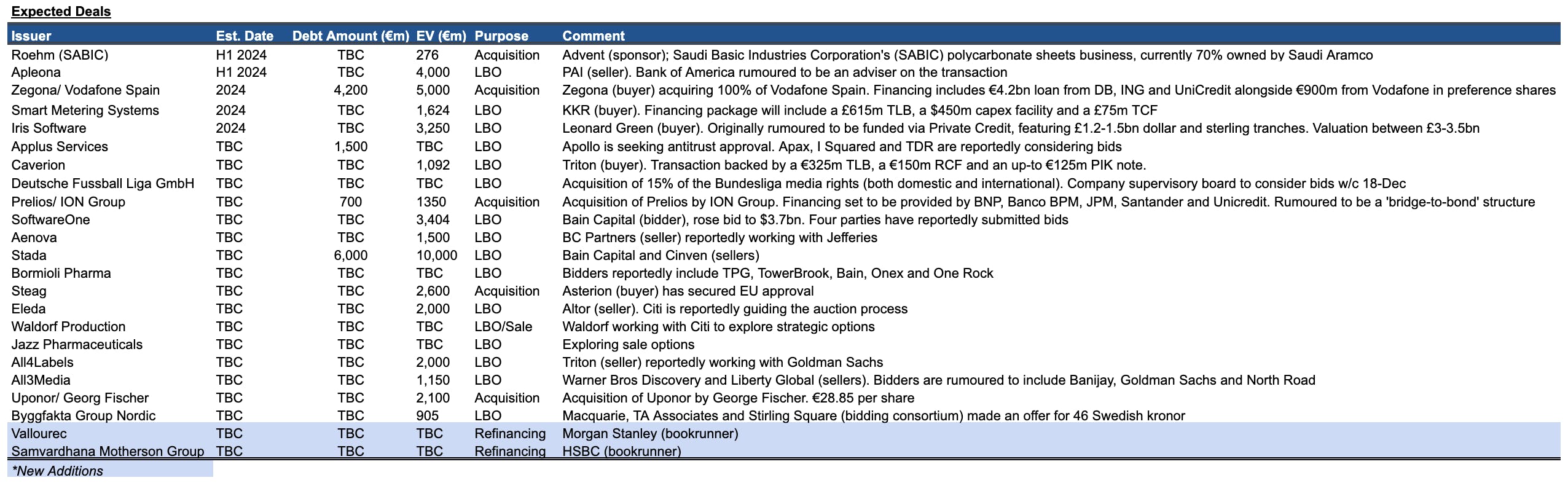
In a way, it’s a similar story for European LevFin primary.
Things are warming up (even if the weather isn’t) as deals begin to filter through but perhaps slower than many expected.
One sellsider was surprised by relatively low LevFin issuance out the gates but still felt optimistic: “I thought there’d be more deals but at least LBO activity in 2024 is shaping up to be better. Things also seem relatively bulled up based on the tightening we’ve seen in primary.”

“The appetite is there,” said a second sellsider. “Everyone is just waiting for the M&A to come through now.”
Despite yesterday’s upside surprise on US CPI, which suggests that higher inflation could linger, the market still remains focused on US rate cuts. The probability of a cut by March from the Fed is around 73% at the time of writing (up from around 70% before the CPI print).
This side of the pond, expectations for a cut by March are much more subdued at 34%. ECB President Lagarde insisted that she “cannot give you a date” for rate cuts, as she looks for more confirmation that inflation is heading towards 2% again.
A buysider said that they remain focused on sector and credit selection despite the market pricing in a soft landing, avoiding segments like traditional retail and real estate.
Despite those worries, they expect issuance to bounce back — given the sheer amount 2025 maturities approaching (covered here and here in our LevFin 2024 Outlooks).
“I need to see inflation drop properly but in spite of that, I think it will be a big year of primary, full of refis.”
High yield
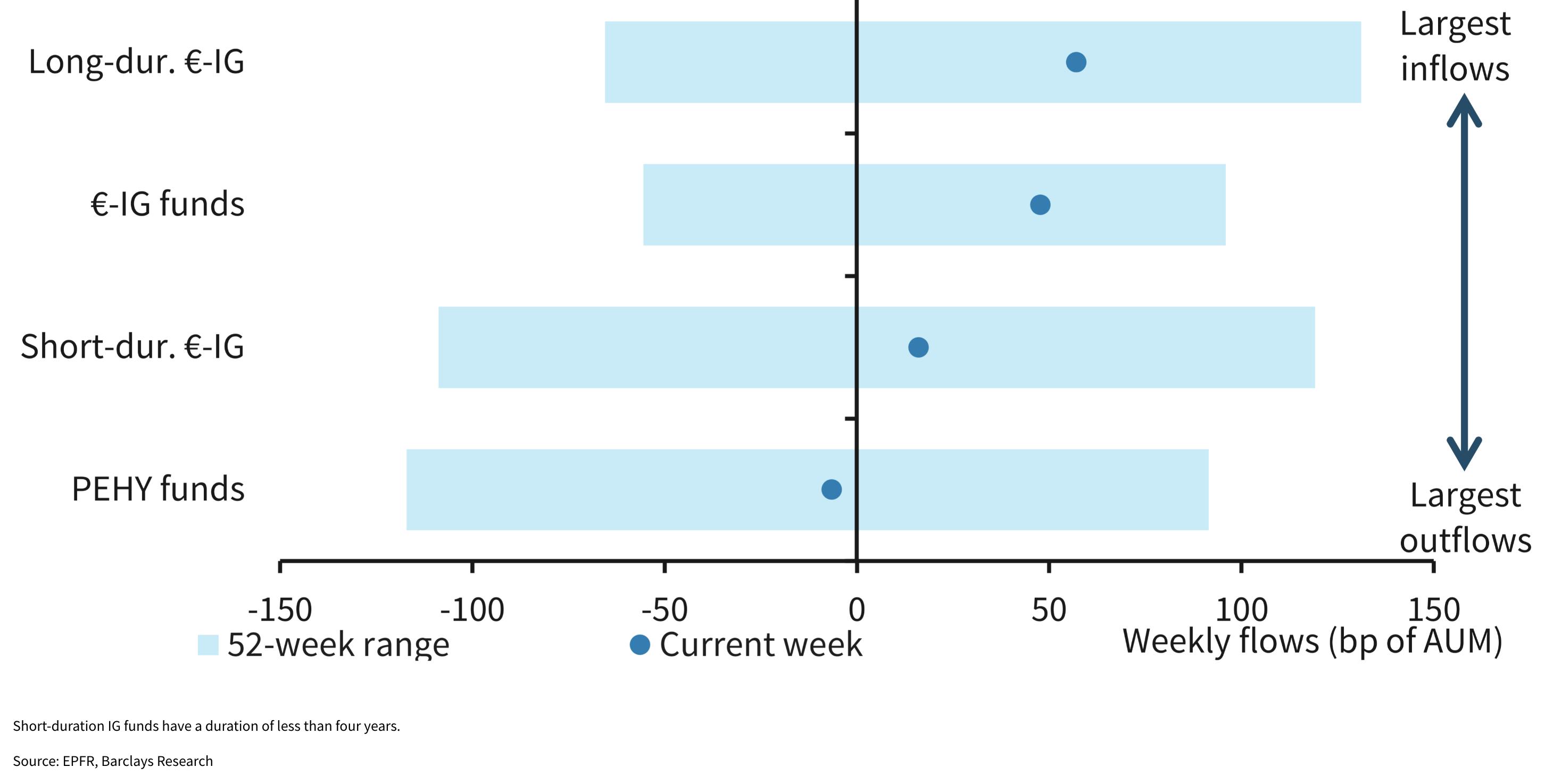
EHY saw its first outflow for 11 weeks over the period 4-10 January as per Barclays Research, driven by mutual funds. The decline was modest but perhaps underlines a growing investor demand for duration in markets such as long-duration European IG where there was the largest relative inflow (especially in ETFs).
Front of the EHY primary queue was Q-Park, issuing €430m of 5NC2s.
A second buysider said: “It’s a reasonably strong credit; the sort of deal that can get the market comfortable as it’s a straightforward refi so should do well.”
And do well, it did.
Despite buyside expectations and initial price talk in the mid-5s area, the deal ended up pricing at 5.125% — highlighting attractiveness of the current window for issuers compared to much of 2023.
“I wanted 6.5% but that’s me wanting some value in the bonds to appreciate,” said the first buysider. “I probably would have bought at high-5s but it ended up being far too tight.”
This was followed by Swedish passenger and freight ferry services company Stena which priced $700m of 7NC3s at 7.25%, in line with price talk.
The first buysider, who is an existing investor said: “It’s a great, stable business. Well managed, too. That said, you’ve got some cyclicality risk.”
Rounding off the bond deals for the week, Italian paper and label manufacturer Fedrigoni used the market’s momentum to achieve a “hefty coupon reduction versus outstanding paper,” according to a third sellsider.
The deal finalised at E+400bps for its €665m issue of 2030 FRNs, which are intended to refinance €735m of E+600bps 2027 SS FRNs, alongside other cash raised from a sale and leaseback transaction.
In October 2022, the company came to market with €300m of 2027 SSNs at 11% and 97.25, plus €572.7m of FRNs at E+600bps and 91 OID, funding BC Partners’ purchase of a 50% stake in the business from existing sponsor Bain Capital. These bonds were then supplemented with smaller private add-ons and taps.
“The LBO was made during terrible market conditions. By deciding to ask for debt, they had to take the pain for the acquisition. The fixed notes will probably be refinanced in October,” said a buysider, who had not previously bought the company’s debt.
The fixed rate 2027s become callable at 105.5 in October.
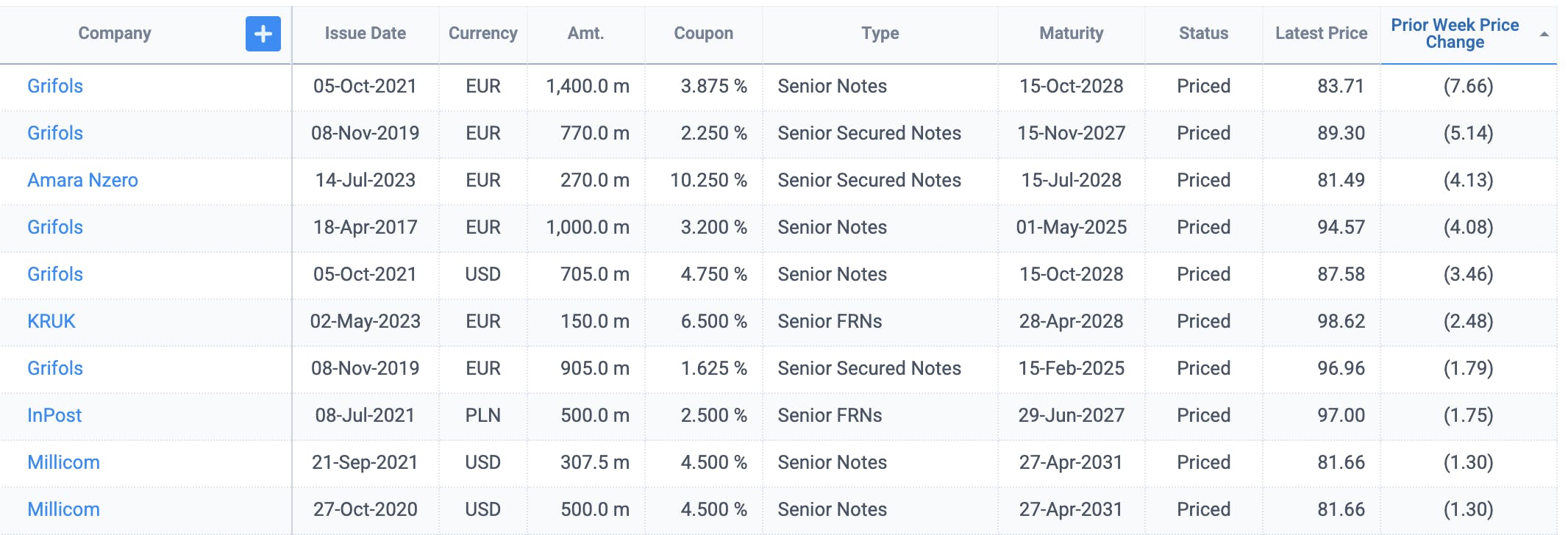
In secondary trading, Spanish biopharmaceutical company Grifols saw most of the action, with bonds and loans both selling off (€1.4bn October 2028 SUNs were hit the worst, down more than seven points at the time of writing) following the publication of a report from activist short seller Gotham City Research (we’ll leave the Batman jokes for another time).
As 9fin wrote earlier this week, Gotham’s short thesis revolves around the fact that Grifols consolidates the results of two companies — Haema and BPC Plasma — into its accounts, despite not owning any equity in these businesses. Combined, these two businesses account for around 40% of Grifols’ profit, according to Gotham.
In the days since, Grifols management has hit back against the claims of the report but nevertheless admitted there is room to improve communications and governance.
The second buysider said: “I think six months ago this could have created a much bigger mess [for the market]. It’s almost like a mini stress test for the market to see how resilient it is.”
You can see our in-depth reaction to Grifols and more in this week’s edition of the Friday Workout.
Leveraged loans
Loan supply hasn’t hit full stride yet but we did see Parts Europe announce a bond-to-loan refi, in the shape of a €580m TLB due 2031. Proceeds will be used to refinance existing bonds due 2025, suggesting an issuer preference for floating versus fixed liabilities and flexible call schedules as 2024 rate cuts beckon.
US-based chip equipment maker MKS Instruments is targeting a $744m-equivalent 2029 TLB add-on split between its existing $3.6bn TLB and €593m TLB due 2029. Proceeds will take out a TLA facility of equivalent size. The currency split has yet to be determined, with talk on the dollars at S+250bps and 99-95 vs E+300bps and 99 for the euros.
French biometrics specialist Idemia approached the market for a repricing of its $750m 2028 TLB. Initial price talk is targeting S+425bps from S+475bps existing.
“We’ll see a lot of these repricings now as companies factor in rate cuts,” said the second sellsider whilst the second buysider said: “It’s painful but that’s life” as margins from existing paper in the portfolio drift down.
Adding to that loan supply, 9fin covered the flurry of BWICs hitting the market across the US and Europe, sparked by CLO redemptions. You can check out the full breakdown here.
Syndicated markets got some good news in the ongoing battle for supply with private credit through IRIS Software. As 9fin has written, debt will stay with the UK software provider’s existing TLB lenders in spite of a co-controlling investment from Leonard Green in December 2023, as the incoming US sponsor’s participation is not large enough to trigger the change of control clause that would necessitate repayment of existing debt.
We also got word that one Nordic deal formerly financed in private credit would be coming out as a syndicated deal early this year.
It’s a topic we’ve covered in detail here and here — encouraging reading for any LevFin bankers who had gotten used to their lunch being eaten regularly by private credit during 2023.
Is 2024 the year of the get back as syndicated markets get cheaper?
Weekly high yield movers
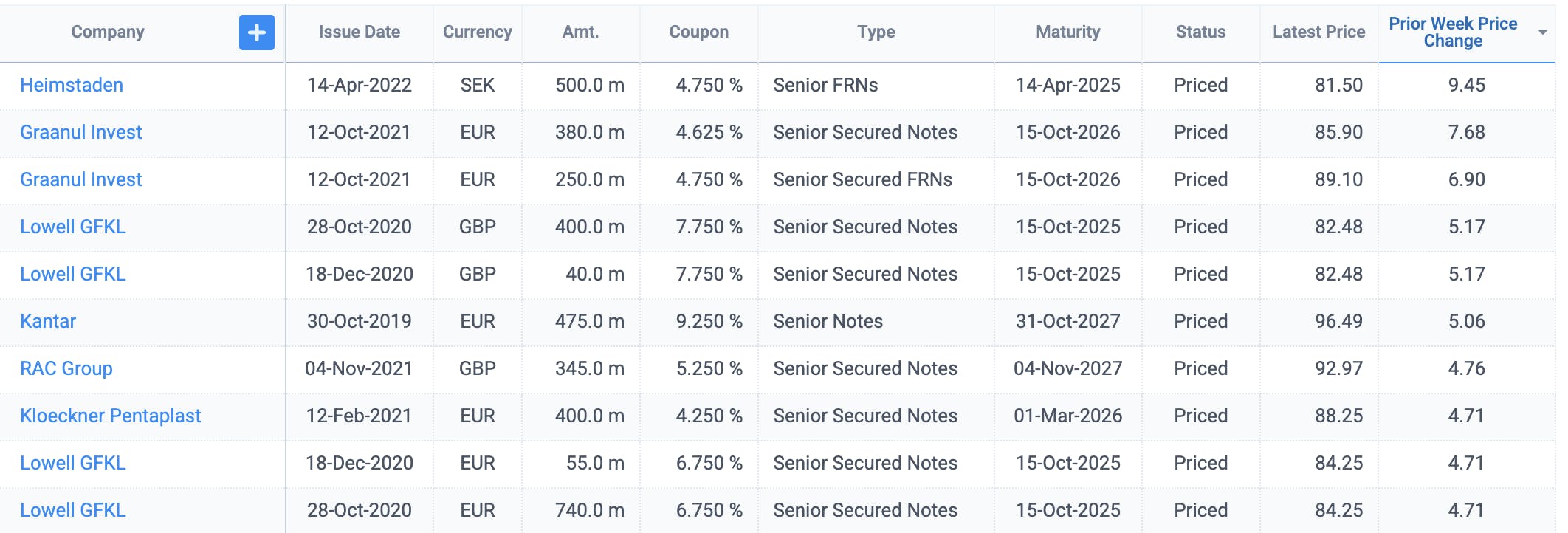
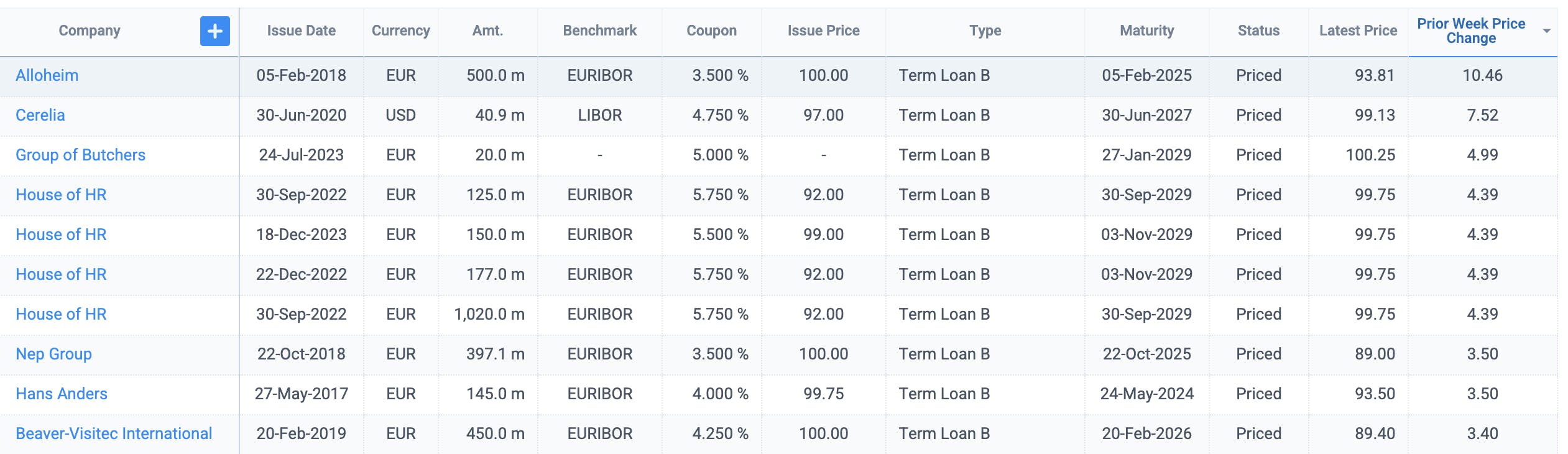
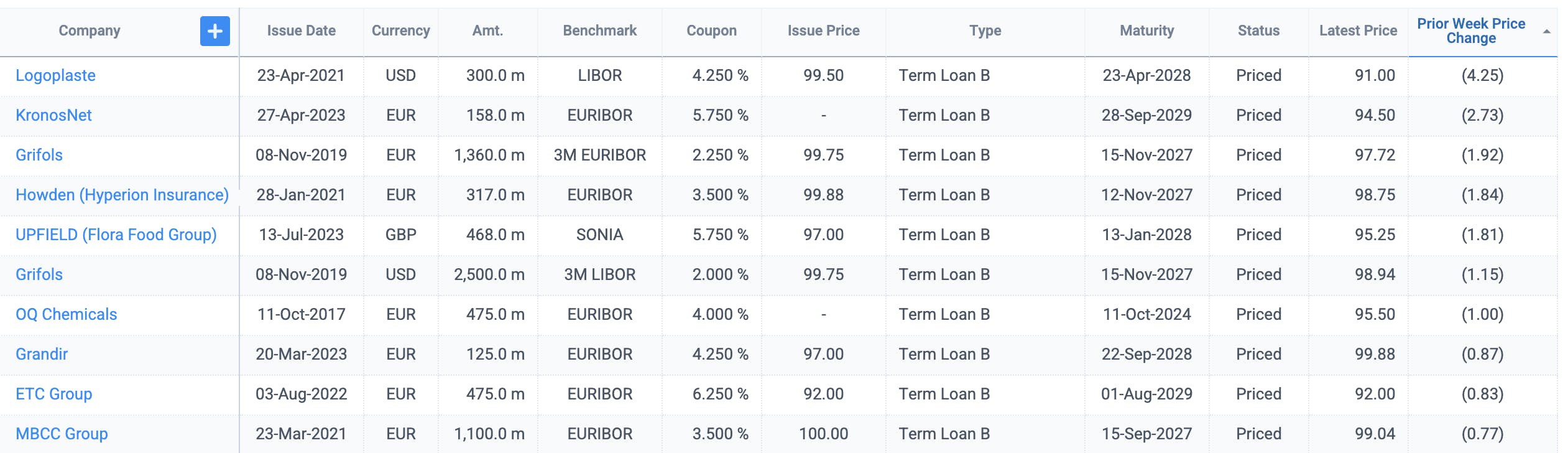
Weekly leveraged loan movers
Forward pipeline